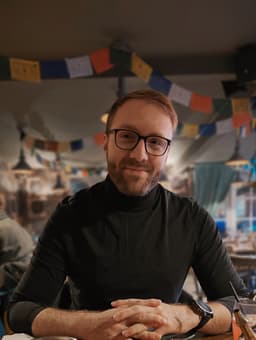
Martin Roček is a medieval philologist by training and a digital humanist by practice. He holds a PhD in Medieval and Neo-Latin Studies from Charles University in Prague. His research spans traditional philology and digital methods: he remains interested in oneiromancy and textual transmission, as well as the tools scholars use to study them and user experience and design more broadly. He teaches UX and Digital Humanities in Prague, is a member of Lucie Doležalová’s ERC CZ project Innovation and Inertia: The End of Medieval Scribes, and collaborates with the Digital Lab at the Institute for Medieval Research of the Austrian Academy of Sciences. His digital humanities work mostly consists of building things researchers need. He created a platform for detection of text reuse in medieval Latin as part of his doctoral research on medieval dreambooks. Currently, he is working on two tools tackling different topics, MANU (manu.is), a collaborative IIIF-based workspace for manuscript annotation and transcription; and Translucens, a tool that removes ink bleed-through from manuscript images. He is also a co-developer of the online Bosworth-Toller Anglo-Saxon Dictionary and NajdiSlovo.cz. He runs humanities.tools, a curated catalogue of tools for the DH community. He also contributed to the Erasmus+ project ANTIDOTE (Advanced Training in Digitisation of Older Texts) and Hands:On, the Cambridge University Library and Queen Mary University of London hackathon where humanities postgraduates prototype digital tools for manuscripts and artefacts. His methodological interests include NLP, IIIF, TEI, digital editions, and UX/UI.