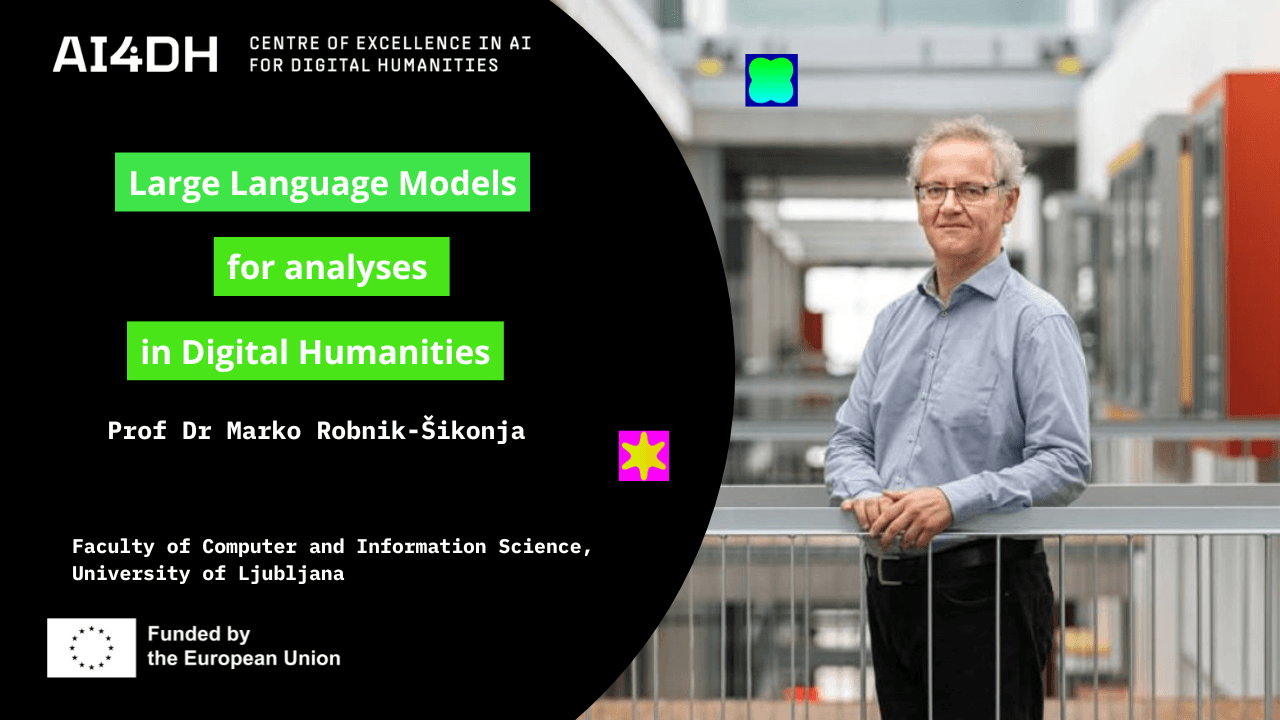
Large Language Models for Analyses in Digital Humanities

Prof. Dr. Marko Robnik-Šikonja explains the working of Large Language Models (LLMs) needed to understand their performance. In the context of complex phenomena analyses, we discuss the two most frequent adaptations of LLMs, fine-tuning and prompt engineering, on the example of social media analysis and folkloristics. We emphasise the need to establish trust in their performance when analysing complex phenomena, outlining the evaluation methodology.
Learning Outcomes
After watching this video, learners will be able to:
- employ LLMs in digital humanities research
- understand prompt engineering and how to fine-tune LLMs.
- understand LLM capabilities and shortcomings.
- understand statistical evaluation of LLMs.