
Immersive AR/VR for Collaborative Heritage Exploration and Decision-Making
- Authors

- Topics
This resource is based on the presentation Immersive AR/VR for Collaborative Heritage Exploration and Decision-Making by Lucía Iglesias (HolaVR), developed for the ARTEMIS Summer School 2026 in Hof, Germany. It shows how immersive technologies are used to support collaborative exploration, interpretation, and decision-making in cultural heritage through shared AR and VR environments.
Introduction
Collaboration plays a central role in the preservation and management of cultural heritage. Digital technologies have introduced new ways of working with heritage assets, moving beyond desktop applications and three-dimensional models towards immersive environments. Augmented Reality (AR) and Virtual Reality (VR) enable immersive visualisation, real-time remote interaction, and more contextualised forms of collaboration, creating new opportunities for heritage exploration and decision-making.
Learning Objectives
After completing this resource, learners will be able to:
- distinguish between Extended Reality (XR), Virtual Reality (VR), and Augmented Reality (AR);
- explain why collaborative decision-making is important in cultural heritage contexts;
- identify different stakeholder perspectives involved in heritage management and conservation processes;
- describe how immersive technologies can support collaborative heritage exploration and decision-making;
- recognise the functions of selected interaction tools in shared AR/VR environments, including navigation, timelines, material layers, viewpoints, annotations, and section cuts;
- reflect on the opportunities and limitations of immersive technologies for cultural heritage applications.
Target Audience
This resource is intended for:
- students and early-career researchers in Digital Humanities, Heritage Studies, Archaeology, Architecture, Conservation, and related disciplines;
- cultural heritage professionals interested in collaborative digital workflows;
- researchers and practitioners exploring the use of immersive technologies in heritage contexts;
- educators seeking introductory material on AR/VR applications for cultural heritage.
Intended Impact
Upon completion of this resource, learners will have gained an introductory understanding of how immersive technologies can support collaborative processes in cultural heritage. They will be able to critically discuss the potential of AR and VR for heritage exploration and decision-making, identify possible application scenarios, and recognise both the benefits and the practical challenges associated with implementing immersive collaborative environments.
Requirements
No prior experience with Augmented Reality or Virtual Reality technologies is required.
A basic understanding of:
- cultural heritage documentation and management;
- three-dimensional digital representations of heritage assets;
- collaborative and interdisciplinary approaches in heritage contexts
is beneficial but not essential.
Suggested Learning Path
For learners who are new to immersive technologies, it is recommended to first watch the video resource From Immersive Storytelling to Experimentation in a Multiscale Modelling Approach. The video provides an introduction to immersive environments and multi-scale digital models, while the present text resource extends these concepts by examining their use in collaborative heritage exploration and decision-making.
Essential Terminology: XR, VR, and AR
Digital technologies are increasingly transforming the way cultural heritage is documented, explored, and managed. Among these technologies, Extended Reality (XR) provides new opportunities for experts to visualise, analyse, and discuss heritage assets within immersive digital environments.
Extended Reality (XR) is an umbrella term that encompasses both Virtual Reality (VR) and Augmented Reality (AR). Although both technologies support immersive experiences, they serve different purposes and are often most effective when used together.
Virtual Reality (VR) replaces the physical world with a fully digital environment, offering a high level of immersion. Users can enter reconstructed heritage sites, inspect historical buildings, and explore archaeological remains from within the virtual space.
Augmented Reality (AR) enriches the physical world by overlaying digital information onto real environments, providing a medium to low level of immersion. This allows users to access contextual information, visualisations, and guidance while remaining present at the heritage site.
Rather than competing technologies, VR and AR provide complementary ways of interacting with cultural heritage. Together, they support more informed exploration, interpretation, and communication by allowing users to move seamlessly between physical and virtual contexts.
Why Collaborative Decisions Matter
Safeguarding cultural heritage is a multidisciplinary task that requires the integration of diverse forms of expertise. No single specialist possesses all the knowledge needed to understand a heritage asset or determine the most appropriate conservation strategy. Instead, effective decisions emerge through collaboration among experts with different perspectives.
Each discipline contributes unique knowledge to the decision-making process:
- Archaeologists provide historical and archaeological context while identifying elements that must be preserved.
- Architects evaluate how interventions can be implemented safely and assess the structural implications of proposed changes.
- Site managers consider public use, accessibility, and long-term management requirements.
- Engineers assess material conditions, structural behaviour, and the technical feasibility of interventions.
Collaborative decision-making becomes especially important when addressing complex challenges such as adapting fragile heritage sites for visitors, responding to natural disasters, or planning conservation work that must balance preservation requirements with public access.
Because these decisions often involve interpreting complex spatial information, effective collaboration depends not only on sharing knowledge but also on developing a shared understanding of the heritage asset itself.
Why Immersive Collaboration?
Immersive technologies provide a common spatial environment in which experts can explore, analyse, and discuss cultural heritage together. By visualising the same asset simultaneously, participants gain a shared frame of reference that improves communication and supports evidence-based decision-making.
In particular, immersive environments enhance:
- spatial understanding;
- perception of scale;
- contextual awareness.
Each technology contributes in different ways.
Virtual Reality supports collaborative work through:
- full-scale exploration of heritage sites;
- visualisation of historical reconstructions;
- remote access to inaccessible or endangered locations.
Augmented Reality complements these capabilities by enabling:
- on-site visual overlays;
- contextual annotations linked to physical objects;
- guidance and information during live inspections and decision-making.
When combined, AR and VR create flexible collaborative workflows that allow experts in different locations to examine the same heritage asset, exchange observations, and evaluate possible interventions within a shared digital context.
Creating a Shared VR Collaborative Space
One of the ARTEMIS use cases focuses on creating a shared Virtual Reality (VR) environment that supports the collaborative monitoring and assessment of cultural heritage assets. Instead of working separately with drawings, photographs, or reports, experts from different disciplines can enter the same immersive virtual space. There, they can interact with a common digital representation of the heritage asset. This shared environment enables participants to explore the site together, exchange observations in real time, and collectively evaluate conservation challenges and possible interventions.
The collaborative VR environment is designed to support the complete decision-making process. Participants first explore the heritage asset, then capture observations and evidence directly within the virtual environment, validate findings through discussion with other experts, and finally translate these outcomes into conservation reports, restoration plans, maintenance activities, or recommendations for public interpretation. In this way, immersive collaboration becomes not only a tool for visualisation but also a platform for structured decision-making.
To facilitate these activities, the shared environment provides a set of interactive tools that allow users to investigate the asset from multiple perspectives while documenting their observations and decisions.
Navigation
Navigation tools enable users to move freely through the virtual environment by walking, teleporting, orbiting around objects, or changing scale. Participants can examine the asset from a human perspective, inspect elevated structures, or zoom out to obtain an overview of the entire site. Flexible navigation allows experts to focus jointly on specific areas of interest during collaborative discussions.
Timelines
Timeline tools allow different historical phases or intervention stages to be visualised and compared. Experts can examine how a monument has evolved over time, analyse previous restoration campaigns, or discuss alternative conservation scenarios by switching between temporal states of the model. This supports decisions that require an understanding of both historical development and future interventions.
Material Layers
Material layers provide access to multiple sources of information within the same model. Users can reveal surface textures, areas of material decay, structural information, laser scan data, or hypothetical reconstruction layers. By switching between these datasets, specialists gain a more comprehensive understanding of the asset while integrating archaeological, architectural, and engineering evidence into a shared interpretation.
Viewpoints
Viewpoints allow participants to save predefined observation positions and expert perspectives. These viewpoints can be shared with collaborators to guide inspections, revisit important findings, or document exactly where a discussion or assessment took place. They also support guided tours and structured review sessions by ensuring that all participants focus on the same features.
Annotations
Annotation tools enable experts to record comments, questions, evidence, and preliminary decisions directly within the three-dimensional environment. Because annotations remain attached to their spatial location, they preserve the context of discussions and create a transparent record of the collaborative decision-making process. This allows participants to review previous observations, justify decisions, and communicate findings more effectively.
Section Cuts
Section cuts make it possible to slice through the virtual model and inspect hidden architectural or structural elements. This enables experts to investigate construction techniques, analyse internal structures, and better understand how different building components relate to one another without altering the original digital model. Such functionality is particularly valuable when evaluating structural conditions or planning conservation interventions.
Supporting Collaborative Decision-Making
Taken together, these interaction tools create a collaborative digital workspace rather than simply a virtual visualisation. Archaeologists, architects, engineers, site managers, and other stakeholders can simultaneously inspect the same heritage asset, exchange knowledge, compare evidence, and evaluate alternative conservation strategies. The immersive environment supports a workflow in which observations are explored, documented, discussed, validated, and transformed into concrete conservation actions. By integrating communication, spatial analysis, and documentation within a single platform, collaborative VR contributes to more transparent, informed, and evidence-based heritage management.
From Immersive Sessions to Actionable Outcomes
Collaborative work in immersive environments can be organised as a sequence of interconnected steps.
The process begins with a shared inspection of the asset. Observations are then captured through annotations, viewpoints, section cuts, timelines, measurements, and other forms of documentation. Risks, priorities, and intervention criteria can subsequently be discussed and validated by different experts. The resulting evidence can be exported as structured outputs and applied to conservation reports, restoration plans, maintenance tasks, or public interpretation activities.
Limitations and Challenges
The value of immersive technologies increases when their limitations are recognised, managed, and documented. Several challenges need to be considered, including:
- motion sickness;
- access to hardware;
- interoperability;
- incomplete datasets;
- ownership issues.
Conclusion
Immersive technologies such as Augmented Reality (AR) and Virtual Reality (VR) offer new possibilities for exploring, interpreting, and managing cultural heritage. Their value lies not only in creating immersive visualisations, but also in enabling experts and other stakeholders to work together within shared spatial environments. By combining visualisation, interaction, communication, and documentation, AR and VR can support more informed and collaborative approaches to heritage decision-making.
The interaction tools explored in this resource allow users to examine heritage assets from different perspectives, integrate diverse forms of evidence, and document observations directly within the digital environment. These capabilities can help transform collaborative exploration into structured processes that contribute to conservation planning, maintenance, restoration, and public interpretation.
At the same time, immersive technologies should not be understood as solutions in themselves. Their implementation involves practical and organisational challenges, including access to appropriate hardware, interoperability, incomplete datasets, ownership issues, and user-related factors such as motion sickness. Successful applications therefore require careful consideration of the specific heritage context, the needs of different stakeholders, and the available data and resources.
Ultimately, AR and VR applications for cultural heritage should be:
- heritage-led, responding to the needs and values of the heritage asset;
- human-centred, considering the perspectives and requirements of users and stakeholders;
- collaborative, supporting the exchange of knowledge across disciplines;
- decision-oriented, contributing to evidence-based assessment and action.
When these principles are considered, immersive environments can become more than tools for visualisation. They can serve as collaborative spaces in which heritage assets are explored, evidence is shared, perspectives are discussed, and informed decisions are developed collectively.
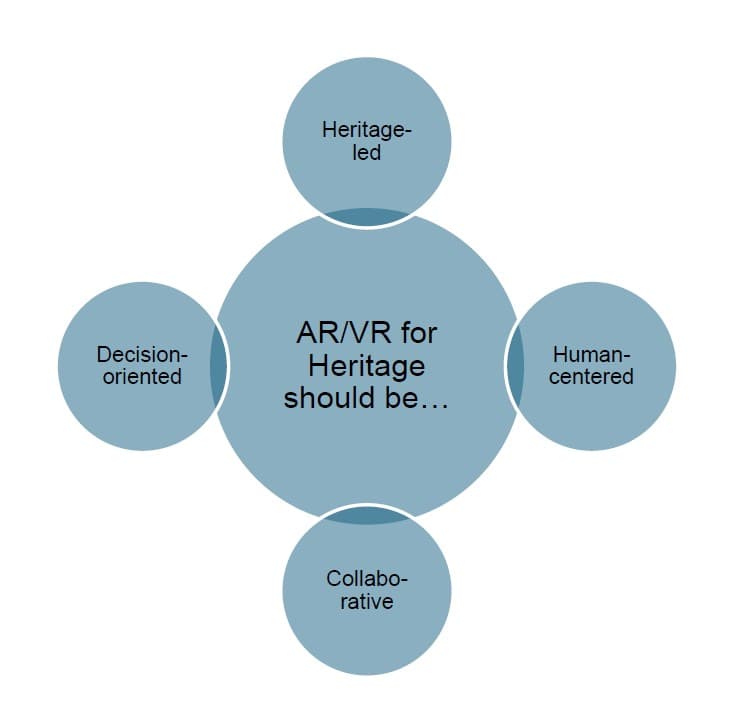
Key principles for AR/VR applications in cultural heritage
Immersive technologies are therefore not only tools for visualisation, but also environments that support collaborative exploration and informed decision-making in cultural heritage contexts.