
Digital Humanities Research Questions and Methods


Collections of Digital Newspapers as Historical Sources
Newspaper Digitisation: New Distortions, New Insights
Newspapers as a Historical Source: Familiar and Complex Materials
Newspapers are a complex historical source, and their digitisation changes our perspective on them: their “datafication” creates new entry points via their transformation into computer-readable material, but it also creates new pitfalls, such as the potential loss of context brought about by keyword searches and the ability to find individual articles without leafing through a whole newspaper. In a digital environment, the neighbouring articles are still accessible but less prominent as on paper.
At the same time, less prominent articles are made visible by the keyword search. Digital transformation requires new techniques of source criticism, since it transform the source (see Jarlbring and Snickars) and may also distance us from some basic elements of source criticism. Before we begin examining digital distortions and enhancements, we will consider a few key questions related to source criticism of historical newspapers.
The Journalist and Historians: Newspapers as the “First Rough Draft of History”
How do newspapers report on historical events? As Stephen Vella explains, newspapers play a key role in what “contemporary readers were made aware [of]” (Newspaper by S. Vella, p. 189). Newspapers are part of the social filter applied to historical events and the traces they left. They are a precious source, but they also distort our perception of past societies as they select only the most “newsworthy” events. For these events, newspapers are an immensely fruitful source, as they report on them on a daily basis. They offer a non-anachronistic discourse on a given event and are therefore an important source for rebuilding the temporality of the perception of a given event, the diversity of its perception and the causes and consequences attributed to the event at the time.
The historian Arlette Farge proposes to look at events as “a fragment of perceived reality that has no other unity than the name given to it”, an event is a “piece of time and action put into pieces”. What is interesting for the historian is that events “shed light on so far unnoticed mechanisms”. In other words, the classical task of a historian is, starting from an event, retrace and analyse its causes and consequences in relation to other events. Of course, the historian goes beyond the simple listing of events and many branches of history have explored other entries in history: the hidden phenomena, non perceived as events, the expected events that did not happen, etc.
There is no one definition of a historical event which would match all uses of the term in historical writing. There are however frequently recurring elements which lend themselves for a more formalized approach. In history, an event is defined by a place, a limited time frame and may involve one or more persons. To become a historical event, it has to have consequences and causes which can be identified, leading up to the event. Else, it is anecdotal. In linguistics, computer science and history, the definition of an event share several common elements: a place, a date, a name, potential actors, consequences and causes.
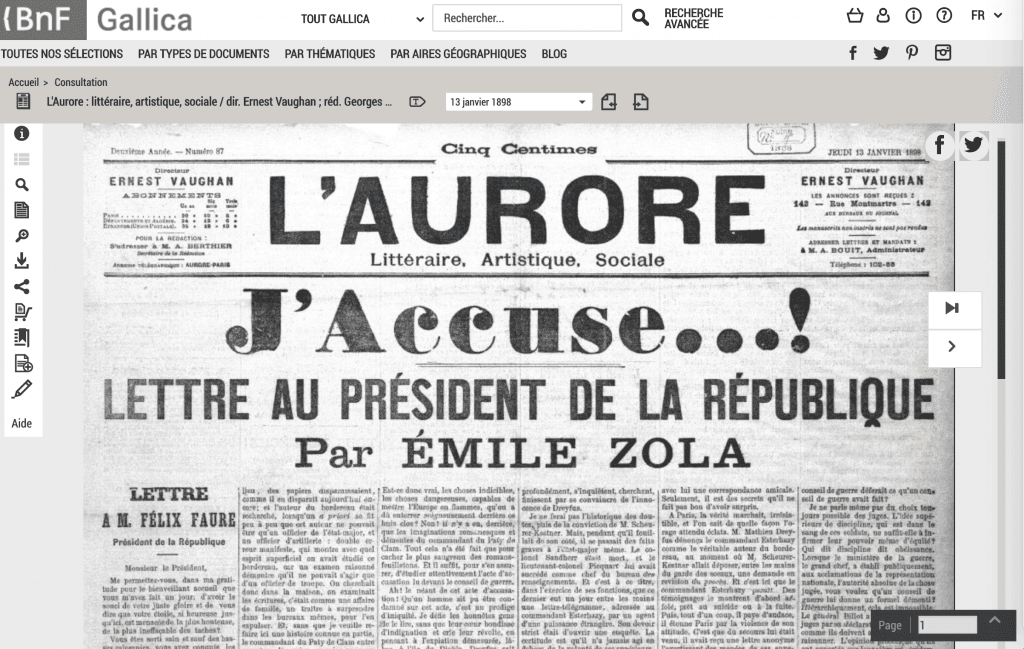
Figure 43 - Famous front page featuring Emile Zola’s open letter
An Example of Media Strategy: the Première of the Rite of Spring in Paris in 1913
Newspapers were soon instrumentalised by public figures to create publicity around cultural events, for instance the scandal surrounding the first performance of Stravinsky’s Rite of Spring in Paris in 1913: as was the practice, Sergei Diaghilev paid a few agitators to create a shout during the show. As it turned out, this appeared not to be necessary as the show shocked the audience with its choreography and music. But how can we understand what happened really that evening in the theatre? Newspapers offer witness accounts and comments on what happened, but these are fragmented and subjective.
A Paradoxical Source: the ‘Transparency’ of Newspapers about their Own History
The paradox of working with newspapers is that they often “transparent” when it comes to their own situation (Vella 2008, p. 193) – their own story often remains invisible. While they record events, publish advertisements and provide information, there is often very little information to be found in their pages about their financial situation, internal struggles and changes of editorial line. Also, the content of newspapers is naturally limited by what journalists are able to print, which may be affected by censorship or a lack of access to information. Newspapers are written by people in particular networks who are influenced by sources of information and pressures of a political, social and financial nature. They depend on income from advertisements, shares and collective or private funding. Newspapers are produced in a particular political, social and technical context: the political regime can shape the conditions of production and publication of newspapers, either by imposing censorship or taxes (Gooding) or on the contrary by offering subsidies. Newspapers have influenced public opinion as much as they have been part of it; they have “enforced or eroded conventional social hierarchies and assumptions”. (Vella 2008, p. 192). Finally, the form newspapers have taken has changed in line with technological progress in terms of printing, transmission of information and taxation. In other words, newspapers have functioned as a “gatekeeper” rather than an objective means of conveying information, and researchers should see them as a “set of habitualised assumptions”. (Vella 2008, p. 192).
The use of newspapers for historical research or media studies therefore requires careful contextualisation and source criticism. The question raised by digitisation is how to practise this source criticism and what new elements need to be incorporated into the process.
Since digitisation and the searchability of newspaper content erase the inevitable hierarchy historians need to apply to their searches in analogue collections, their findings may shed light on events that were reported differently, earlier or only by marginal newspapers. The “flattening” of search practices via keyword searches in digitised newspaper collections can give historians a broader or diversified perception of a given event. And if the collection is multilingual and transnational, it can also help them identify different perceptions of an event by different newspapers, potentially bypassing local censorship or highlighting the instrumentalisation of an event by a particular political camp. This is the challenge we will address in the next part of the lesson.
Digitised Newspapers as New Artefacts
This section written by Marie Annisius
How are the Analogue Newspapers Reconstructed in Digital Form?
Let’s start at the beginning: what exactly are we accessing when we work with digitised newspapers, and how do we access it?
As Pelle Snickars explains, the process of digitisation creates many new layers of information on top of the original source, and the output of digitisation requires a dedicated interface to access it. Digitisation transforms the original source and opens it up for more uses and different means of access. Capturing the analogue source with an scanned image and processing the image with text recognition and layout analysis creates a new source format and changes the potential interaction with it. But raw digital output relies on many technical and institutional constraints, mainly copyright issues, and is not usable as such; many further steps are needed before it can be accessed by researchers. Users must be aware of the context in which it was produced, and also of the fact that the field is constantly changing, both in terms of technical improvement in the digitisation itself but also in the development of interfaces giving access to them. It is important not to lose sight of the fact that collections are being constantly enriched and the technical quality of newspaper digitisation is undergoing continuous improvement. It seems that the real challenge facing holders of digitised newspaper collections is how to provide users with facilitated access to a growing quantity of sources via a suitable interface. Behind seemingly stable institutional search interfaces, the digital newspapers collections are undergoing important and continued changes.
What does Digitisation Mean in Practice?
Historical newspapers are selected by holders, often national libraries, who hold collections of newspapers but do not own the rights to them. Multiple factors determine which of newspaper titles are selected for digitisation: Legal obstacles are one reason why digitisation often starts with older newspaper titles. Another reason why older editions have tended to be digitised first is their fragility. National libraries have the mission to preserve the collections they hold, and digitisation often seems to be an effective way to facilitate access to their collections while protecting them from deterioration caused by use. It can also seem that more popular titles are being digitised first, but this is hard to judge as holders generally do not justify or explain their selection. Another factor are digitisation requests from users which some libraries are happy to consider.
The newspapers are usually transferred to a digitisation company along with a set of requirements defined by the newspaper holder. The holder defines the format and features the digitisation will entail: what quality goals will be set for the text recognition in the newspapers, what segments will be annotated, will the digitisation be based on the paper version of the newspaper or on microfilms made of these newspapers, will the scanning be performed in colour or in black and white? For instance, the holder may request that annotation be enabled for newspaper obituaries, since this feature is very useful for genealogical research to collect names and dates. Enabling annotation means identifying visual elements that characterise these obituaries, such as various cross designs and the text attached to each of them. This identification can subsequently be used as a filter to limit searches to obituaries: users can type a name, select the obituaries filter and retrieve results from these segments of the page only. The segmentation of individual articles is crucial for newspapers, since many different elements are generally found on a single page.
The process of digitisation involves using optical character recognition (OCR) to produce texts, and potentially also document layout analysis methods (also described as Optical Layout Recognition) to recognise individual articles and other visual elements. This information about the text and its location is stored on the basis of two standards – the Metadata Encoding and Transmission Standard (METS) and Analyzed Layout and Text Object (ALTO) – and sent back to the newspaper holder.
What is OCR?
Optical character recognition (OCR) is a relatively old technology that has been in use for many years, for instance since 1971 at Canadian post offices to read addresses on letters. It is a process that recognises text in an image and transforms it into machine-readable and editable text. But how does it work?
First, the material is prepared so that it can be optically processed more easily: the image of the text is straightened out and the contrast of the picture is enhanced. This latter step is called “binarization” – the range of colour shades of an image is reduced to black and white in order to increase the contrast between the background and the letters on the image. The binarized image is then inspected by software that identifies the contours of the letters and words and compares it to known fonts. Taking into account not only each letter but all the letters of a text helps identify the most probable font used for the text. After the identification of letters, more complex processes are performed: the identification of language and the spatial distribution of the text on the image, or layout analysis. The language is identified with the help of dictionaries. This might create some difficulties when dealing with historical texts, as spelling changes over time. Layout analysis is crucial, especially when dealing with newspapers, where the text is distributed over columns.
One final important dimension to be aware of is the measure of the quality of OCR processing. The traditional way to measure the quality of automated processes is to manually compare them to “ground truth”, in other words against real-world observation. For OCR processing, this works by selecting a random sample of articles or pages, transcribing them manually and comparing the ratio of letters and words recognised by the software to the manual transcription. Another way to measure the efficiency of OCR processing is to compare it to dictionaries. This accuracy information is generally used internally by institutions and is rarely published for users via interfaces. Researchers should therefore bear this in mind and develop strategies to analyse the precision and recall of their queries.
The information produced by OCR processing is then stored under two standards:
- Metadata Encoding and Transmission Standard (METS) and Analyzed Layout and Text Object (ALTO). METS was created to store general information about objects in digital libraries. It contains metadata, i.e. the title, date, author, place of publication, and generally speaking the information normally found in a library catalogue. It contains also digital metadata, e.g. when the file was created, by whom, which version of the file it is, what format it is in and how it relates to other files stored in the digital library. Finally, it contains the metadata of the elements contained in the digital file, such as the title of a page or information about its textual content. The standard provides a long list of categories of information that can be used by libraries to store and communicate information about a given file. Not all fields are necessarily completed but METS offers guidelines on how to produce and store this information.
- The ALTO standard, as its name indicates, was designed to store OCR output. It contains information about identified text and its spatial distribution for each OCR image.
Key Points to Remember:
- Digital text via OCR that makes newspapers searchable with keywords.
- Identification of newspaper structure via document layout analysis that enables the application of search filters limited to certain sections of newspapers such as advertisements or obituaries.
- METS/ALTO standards to store information about the characters in the scanned image and their spatial distribution.
- OCR and OLR quality have constantly improved in recent years and recent efforts to use deep learning technologies promise again a significant boost in quality.
Digital Source Criticism Applied to Newspapers
As explained above, the digitisation of newspapers creates new objects that offer enhanced searchability, but particular care is needed when using them. A few questions can help estimate how many articles may have been missed because of OCR mistakes.
- Is the Collection I’m Browsing Prone to Particular Weaknesses Because of its Font?
Digitising historical newspapers involves deciphering a variety of font formats. German-speaking newspapers used to be published in Gothic font (Fraktur), a calligraphic-style font. Standard OCR is prone to more misidentification with this font than with Roman typefaces. Alongside dedicated models for the recognition of Gothic fonts, recently, software developed for handwriting recognition (HWR), also known as handwritten text recognition (HTR), has delivered very promising results.
Users should bear in mind, however, that OCR for Fraktur is still generally speaking weaker than for Roman font collections and should diversify their queries to compensate for this weakness.
Newspapers produced with poor paper quality, for example during wartime or for clandestine purposes, will tend to produce a lower quality scanned version. For instance, pages may be torn, or the paper may be so thin that text from the other side shines through and creates noise for the OCR.
- Is the Query Term Very Common or Very Rare? Is it Long or Short?
The quality of OCR depends on the identification of characters and then post-correction. The recognised characters are checked against lexicons to verify the recognition of words listed in common dictionaries. This processing creates new biases, as Guillaume Chiron (Chiron et alii., 2017) explains. Basing his research on actual queries via the Europeana and French National Library (BnF) interfaces, he observed that many keywords used for queries are often unique and very specific. The more specific they are, the less chance they will be found in standard dictionaries and hence be corrected in the post-OCR correction process. Generally, if a word has more letters, the chances of one letter being misidentified are higher. But this problem can be circumvented with search options offering more flexible query formulation (known as “fuzzy search”) that can be made available for researchers by the search engine.
- Can We Identify Some OCR Mistakes in the Retrieved Articles to Feed New Keyword Lists with these Spellings?
This is the commonly used “snowball” strategy: after the first query of a word, you may come across a different OCR version of the queried word and try it out as a separate query.
- To what extent have the newspapers been segmented?
The OCR processing of newspapers raises a few particular issues, mainly because some periods are characterised by poor paper quality, for instance in wartime, and some fonts used in headlines for articles or on the front page are difficult to read. Another big challenge is segmentation: searching for two keywords in a single article or an entire issue of a newspaper may give very different results, especially when searching for terms that are less frequently associated with each other.
For instance, searching for Argentinian tango and Finnish tango will bring very different results when using collections that allow searches within one article or per issues (see ‘Ranke2’ in the “Further Learning” section at the bottom of this page).
Beyond Big Data: Keeping Things in Proportion
Are there some surprising chronological holes in the list of results? This could be linked to a poor paper quality that leads to poor digitisation output and consequently, poor OCR output.
Some interfaces offer the option of frequency visualisation that can provide an overview of the distribution of results over time. The interface of the Royal Dutch Library, Delpher, has such a feature and is also noticeable because of the option to change absolute frequencies to relative frequencies. Choosing relative values displays the proportion of results compared to the entire digitised collection. See below the example of hits for “Titanic”, where the difference between relative and absolute is not too strong, indicating that a significant proportion of the newspapers that have been digitised covered the disaster in 1912.
You can interact directly with the graph shown in Figs 44 and 45 here: https://www.delpher.nl/nl/kranten/ngram?query=titanic&coll=ddd
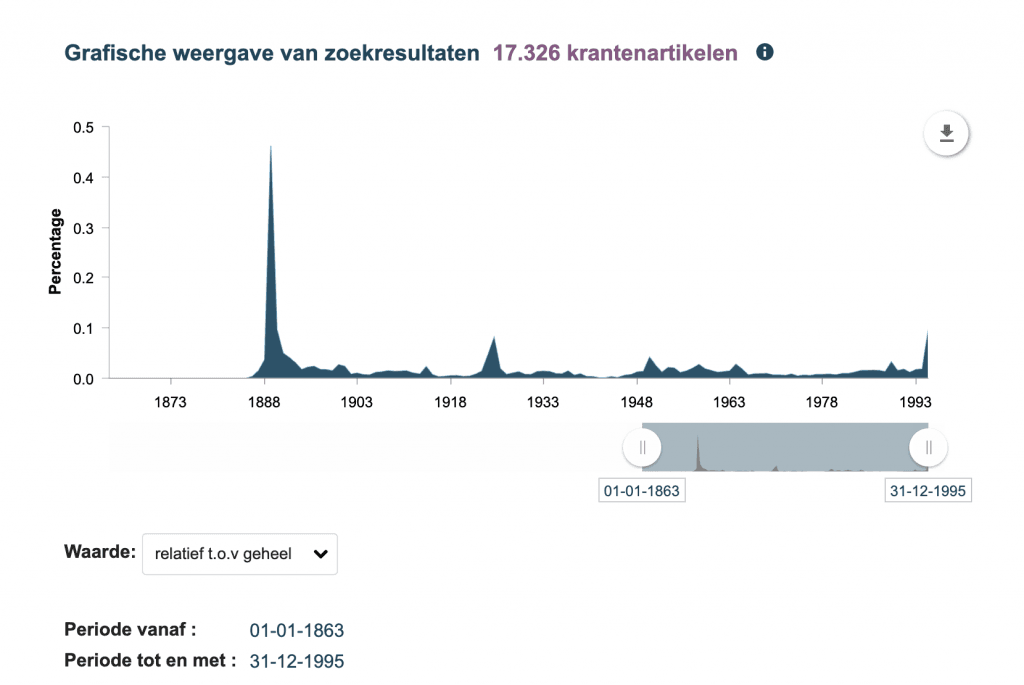
Figure 44 - Delpher Timeline on Titanic - Absolute Frequency
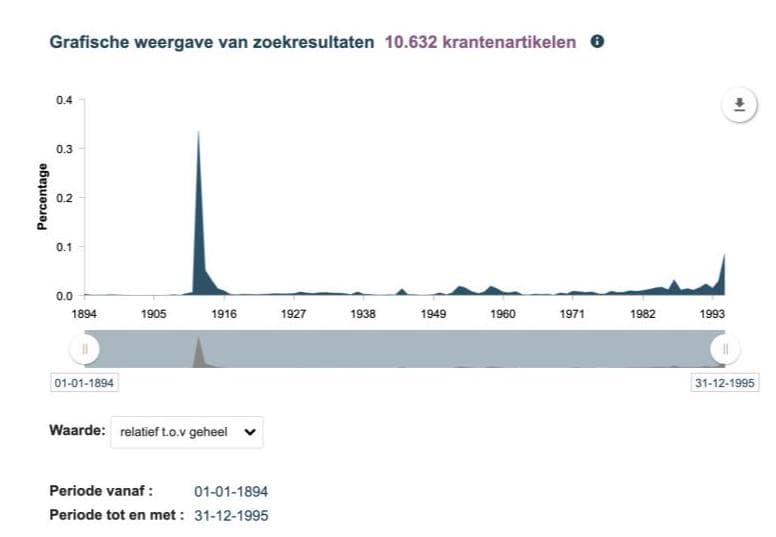
Figure 45 - Depher Timeline on Titanic - Relative Frequency
The query on “Eiffel Tower”, by contrast, shows that the proportion decreases when comparing the two peaks, even though the absolute values are more comparable.
You can interact directly with the graphs shown in Figs 46 and 47 by clicking here: https://www.delpher.nl/nl/kranten/ngram?query=Eiffeltoren&coll=ddd
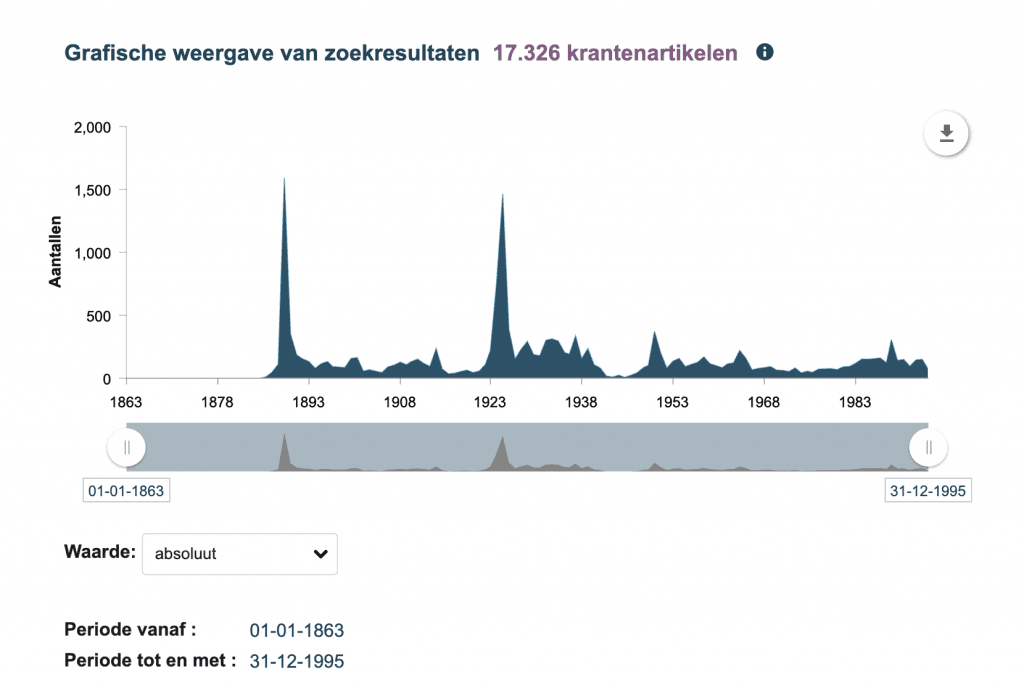
Figure 46 - Delpher Timeline on Eiffel Tower - Absolute Frequency
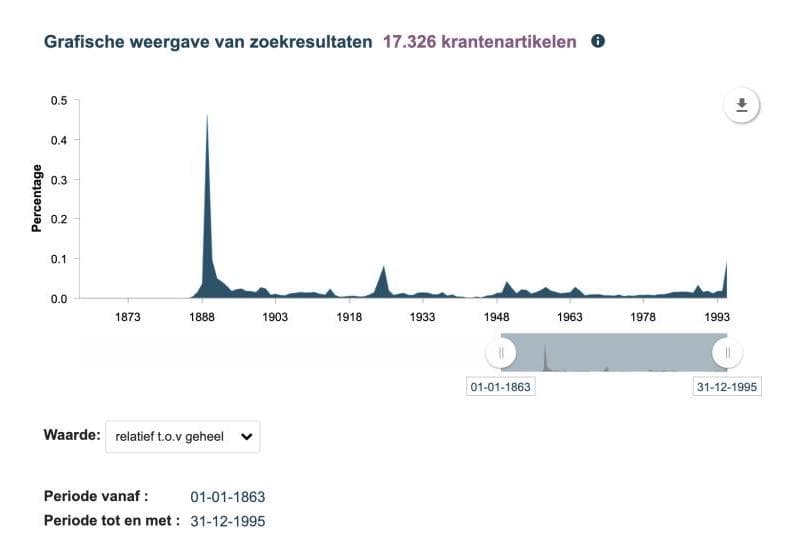
Figure 47 - Delpher Timeline on Eiffel Tower - Relative Frequency
Be Aware of the Missing Elements
There could be several reasons to explain the missing issues of a newspaper in a digital collection:
- the issue may not be available in the archives of the analogue collection
- the issue may have been damaged
- the digitisation may have produced unusable OCR
- the file may have been corrupted
From a user perspective, it is not always possible to estimate what is missing and for what reason. But it is important to be aware of this and to bear it in mind when browsing the collections, rather than just focusing on your queries.
An example of a damaged scanned page can be seen on the ANNO interface: http://anno.onb.ac.at/cgi-content/anno?datum=19120414&zoom=33
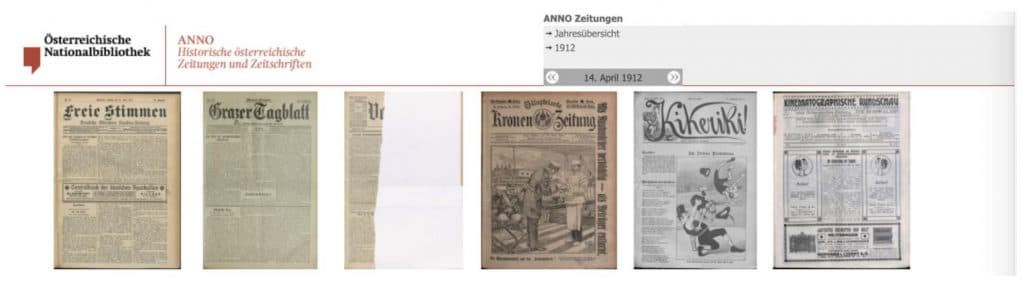
Figure 48. Scans of newspapers from the ANNO interface with ripped out sections or pages.
Digitisation of Newspapers – in Summary
- Optical Character Recognition (OCR) software makes newspapers searchable with keywords.
- The OCR quality varies significantly depending on the quality of the original source, the font used in the newspaper and the performance of the OCR software.
- It is difficult to estimate the impact of OCR mistakes on the search for each keyword, but some keywords are more prone to misidentification, particularly when the word is long or not available in dictionaries used by OCR software.
- As searched words may be repeated in one single article, OCR mistakes can be compensated through machine learning.
- The segmented layout of newspapers can also be digitised via OLR, which opens up the application of new search filters, limited to sections of newspapers such as advertisement, obituaries.
- Metadata standards such as METS/ALTO help to store the location of characters on the scanned image.
- A wider search within a collection using different keywords can help to get a better understanding of the context of the article, and what might be missing from the overall digitised resource.
How to Access the Digitised Newspapers?
Collections of digitised newspapers are part of a more general trend of providing online access to historical sources: there are increasing numbers of digitised cultural heritage collections, digital libraries and web archives. We have seen so far how the digitisation of newspapers functions in a general way; we will now explore how to access currently available collections in practice. The materiality of digitised newspapers is defined not only by the process of digitisation but also by the interfaces produced by the holders of digitised collections to provide access to these collections. Another crucial element over which holders generally have little influence (especially in the case of national libraries) is copyright, which can restrict access to digitised newspapers.
At the end of the digitisation and post-digitisation process, we find ourselves with several types of data, potentially stored in various databases, in different formats and in large quantities. Digitisation and processing create many entry points into newspaper collections: we can potentially search with keywords, filter by time period or language, search for given topics and identify people. But not all interfaces offer all these options. The interface is part of the general workflow of the researcher: queries are formulated based on previous research, and generally the researcher needs to take the results of the queries out of the interface to analyse them.
Interfaces are tools that are developed to organise communication between users and the databases produced by institutions in connection with their digitisation policies. The interface translates the queries and commands formulated by users and presents the answers produced by the databases. Interfaces are also an important place where information on the collections, their scope and the available commands is provided (Ehrmann 2019).
The interface is composed of several elements:
- the viewer, to read the newspapers
- search functions, to formulate queries to the databases
- exploration pages, to provide an overview and browse the collection in different ways rather than just with keyword queries
- contextual information, such as historical information about the newspaper or technical and institutional information on how the collection was produced
- some interfaces propose enhanced search options based on natural language processing, such as named entity recognition or topic modelling
Navigating Institutional Digitised Newspaper Collections
Reading the Digitised Newspapers
Digitised newspapers are not read in the same way as analogue ones. The scale is changed and, as is often mentioned, the context can be lost, as we can jump directly from a search list to a single article.
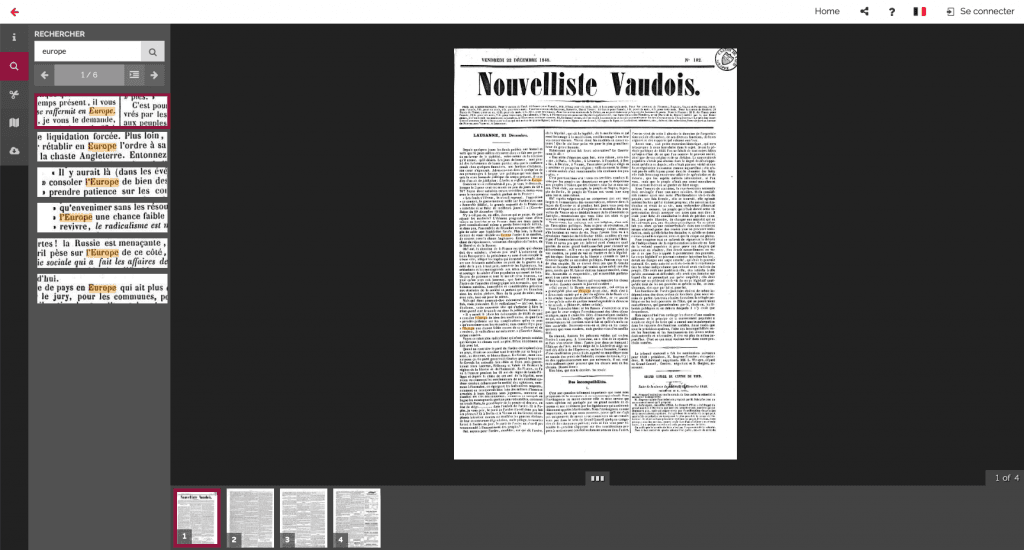
Figure 49. Screengrab of a scanned newspaper in an interface
Some interfaces keep track of the context by providing a list of articles that are on the same page as the article being read. For instance, the California Digital Newspaper Collection lists the titles of articles on the page that is currently open:
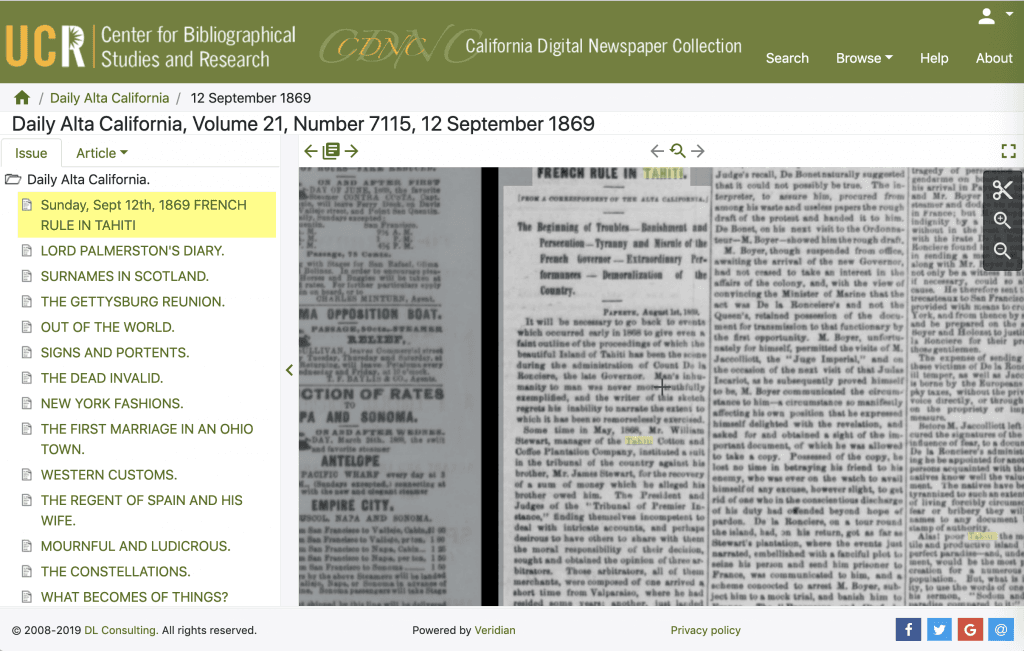
Figure 50. The UCR Center for Bibliograhical Studies and Research Newspaper Collection Viewer
Other interfaces also display the segmentation that has been identified during the digitisation, for instance here in the viewer of the Luxembourg National Library:
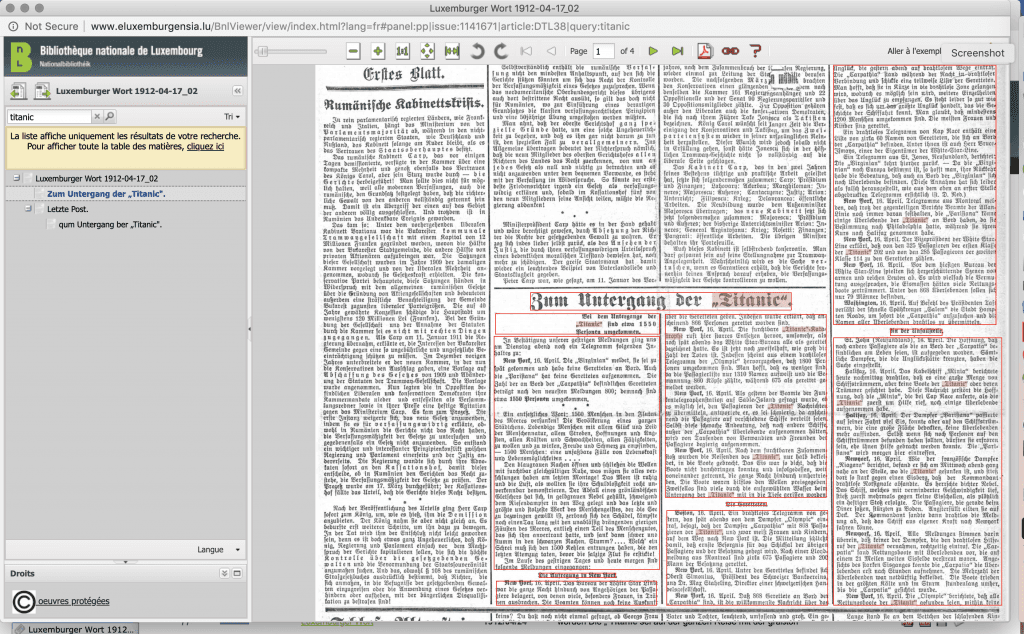
Figure 51. Screengrab of the Luxembourg National Library viewer
This same viewer displays the OCR that has been produced, alongside the scanned image:
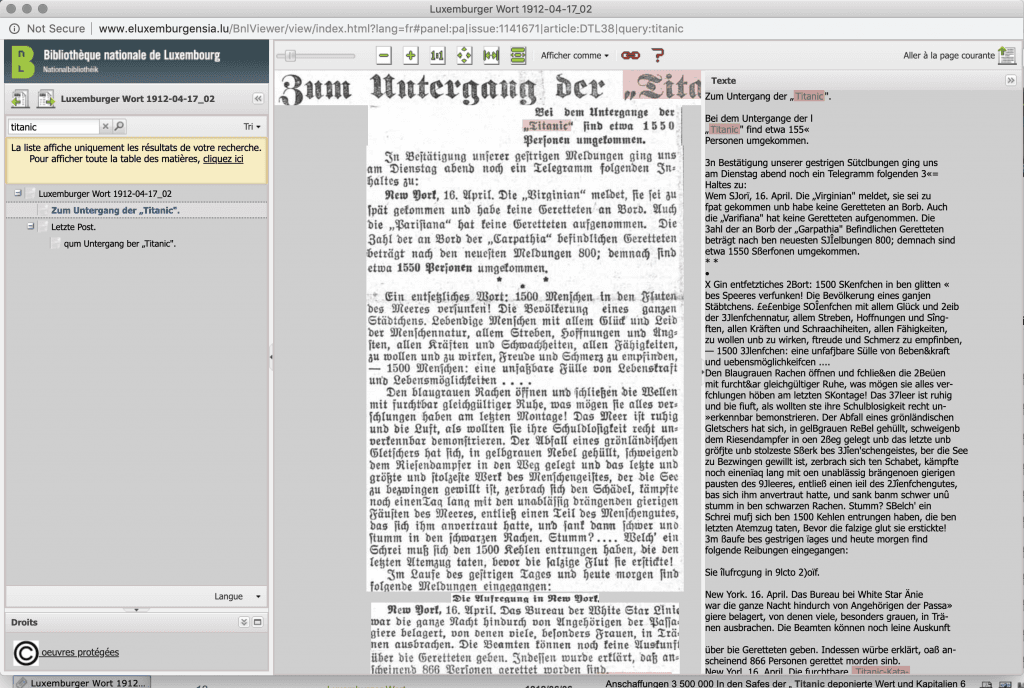
Figure 52. The Luxembourg National Library Viewer with OCR also displayed
Most of interfaces offer the option to navigate from one page to the other in the newspaper issue that is being currently read. Some offer the option to navigate from one result to another:
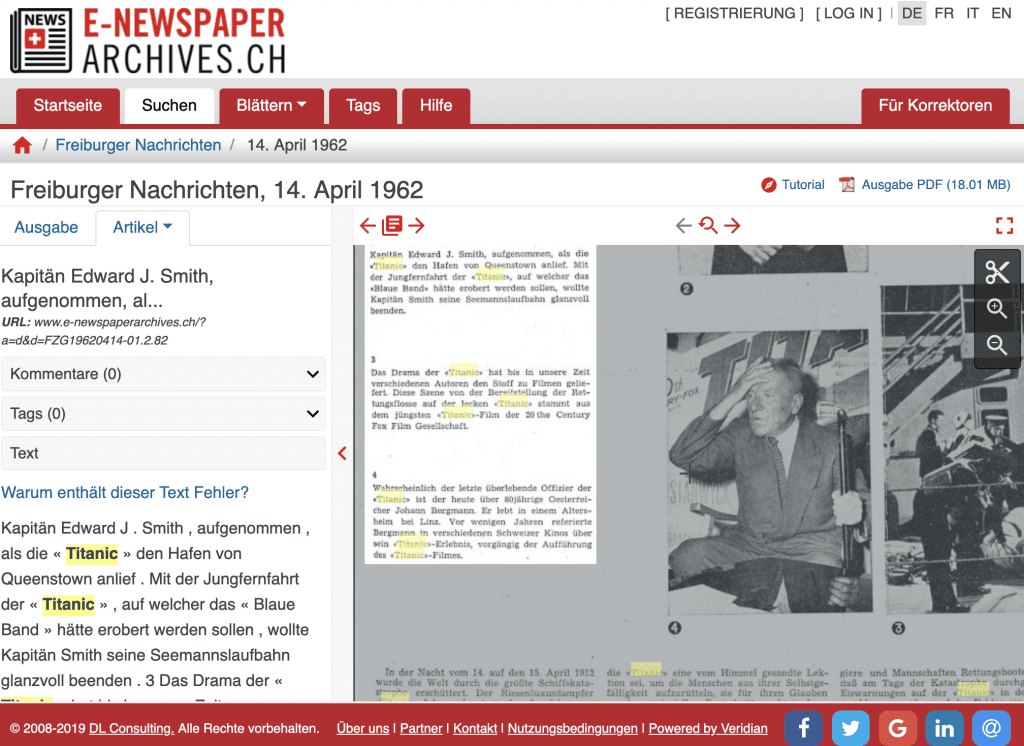
Figure 53. E-Newspaper Archives.ch viewer showing Frieberger Nachrichten 1962
These examples show how some viewer options depend on the prior processing of the newspapers, for example article segmentation and identification of the article title. Others depend more on viewer functionalities: the display of OCR, navigation between results, etc. The viewer is relatively self-explanatory since it uses navigation options that are fairly familiar to us.
Searching the Content of Millions of Pages
The main advantage of digitising newspapers is that it makes them searchable. This depends on the quality of the OCR, as we have seen, but also on various less obvious processing factors and on the design of the database.
Most interfaces offer keyword searches and the option of using metadata to restrict the search results.
When performing a large query, the Delpher interface flags up a warning:
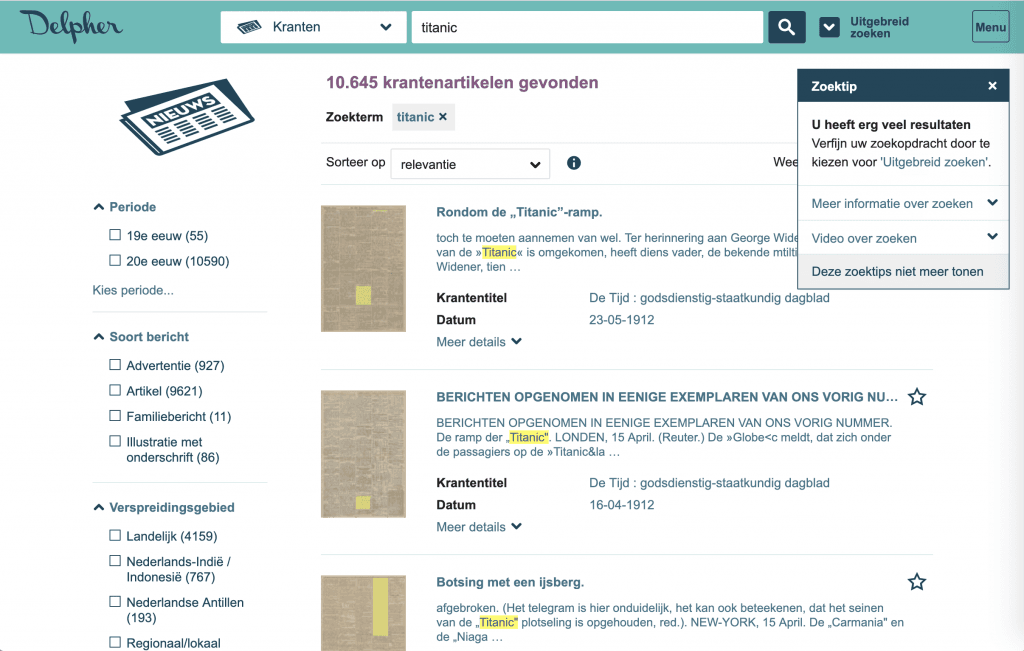
Figure 54. Delpher ‘Zoektip’ popup
Most interfaces present the metadata that can be actioned as filters on the left pane of the interface. It is the content of these metadata that is highly variable. Most of the time we find the same filters as in a library catalogue, such as date, author and newspaper title.
Some other filters are used less frequently, such as ‘place of distribution’, or ‘article type’. In the case of Delpher, it enables the user to limit the search to newspapers published in the Netherlands or in the Dutch colonies. Users can also limit the search to certain broad types of articles: articles containing birth or wedding announcements; an option often of use to historians or genealogists. Users can also search for articles with an image. All of these filters depend on the decisions made during the processing of the collections.
To give some more guidance on keyword searches, some interfaces offer an autocomplete option, based on the content of the collection. For instance, Gallica offers suggestions based on document titles and authors.
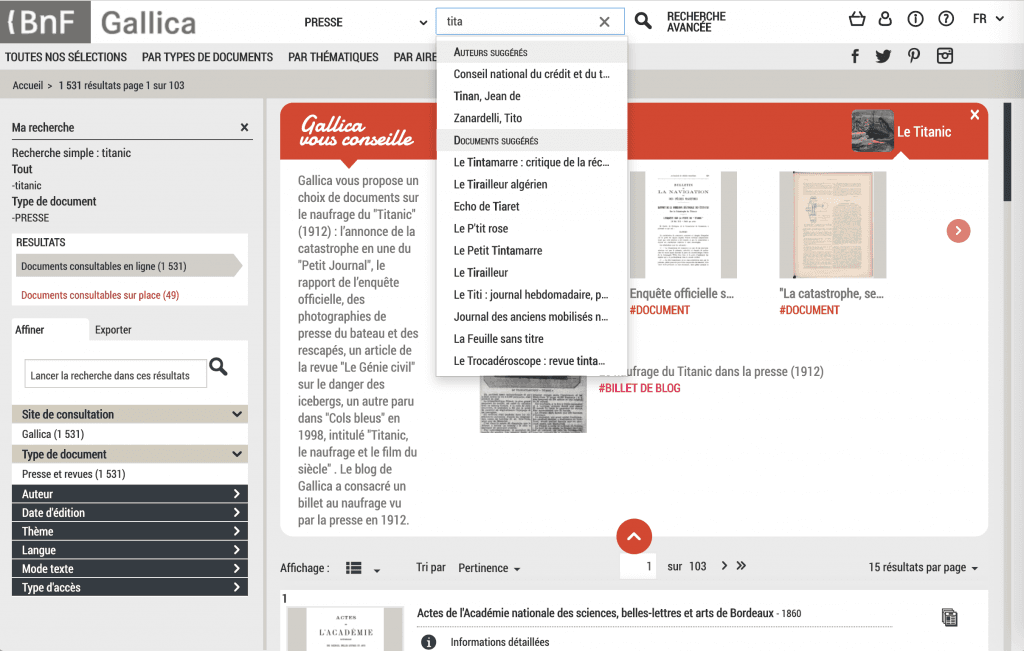
Figure 55. BnF Gallica drop down menu
Navigating the Collections of Digitised Newspapers
Bearing in mind all the limits of OCR and digitisation, users should not hesitate to browse newspaper collections more generally, to gain a broader understanding of what may or may not be available. Some interfaces offer several ways to discover what they contain.
- Newspapers by alphabetical order
- Available titles by country
- Most recently added titles
- Option of browsing the front pages for a given day
The Europeana newspaper interface offers different overviews of its collections:
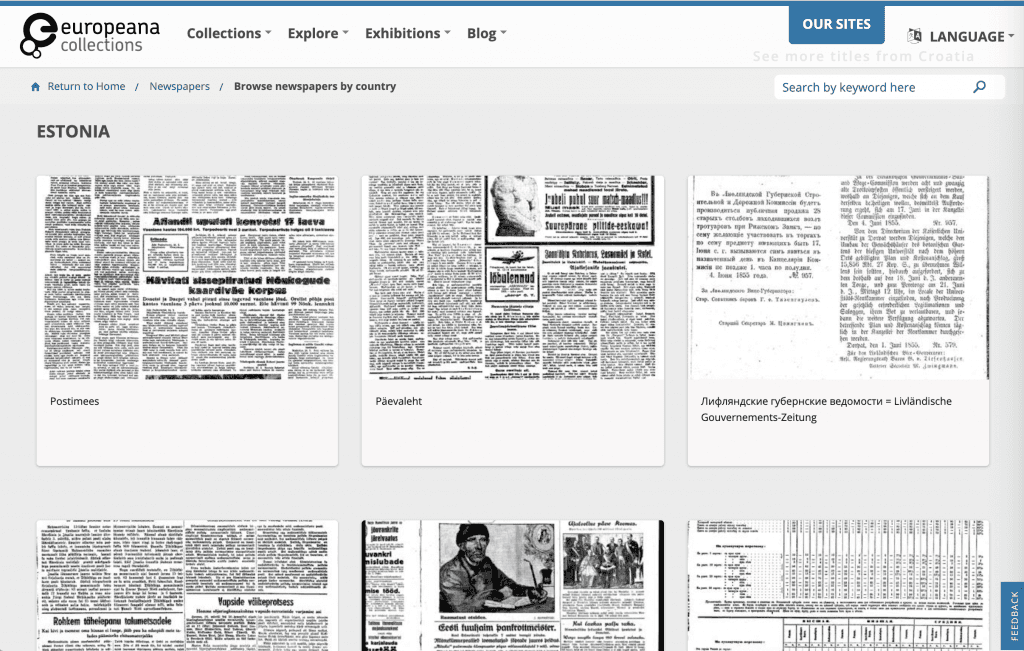
Figure 56. Some of the newspapers in the Europeana collections
Some interfaces inform users of the most recently added titles, such as ANNO:
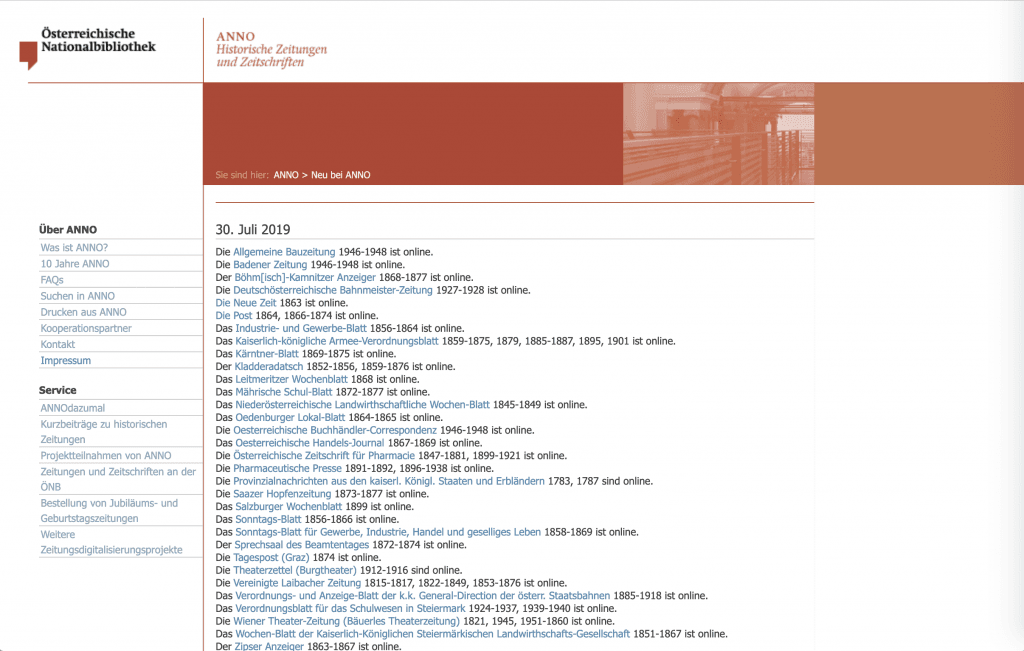
Figure 56. Listings of newspapers available on the ANNO platform
Some interfaces also offer the option of browsing the front pages for a given day.
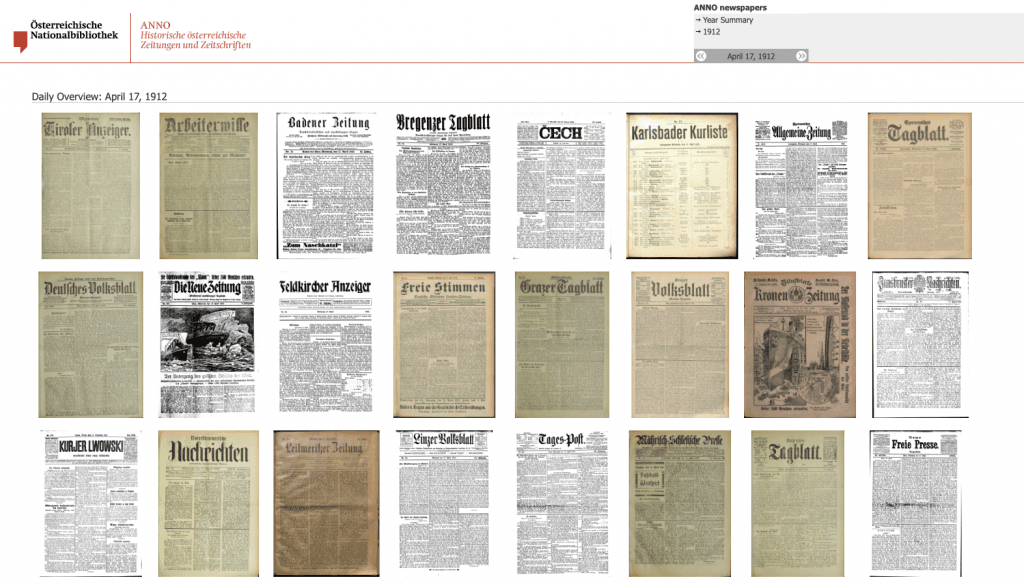
Figure 57. ANNO front page three days after the sinking of the Titanic
A few interfaces add tags to newspaper titles, such as ANNO:
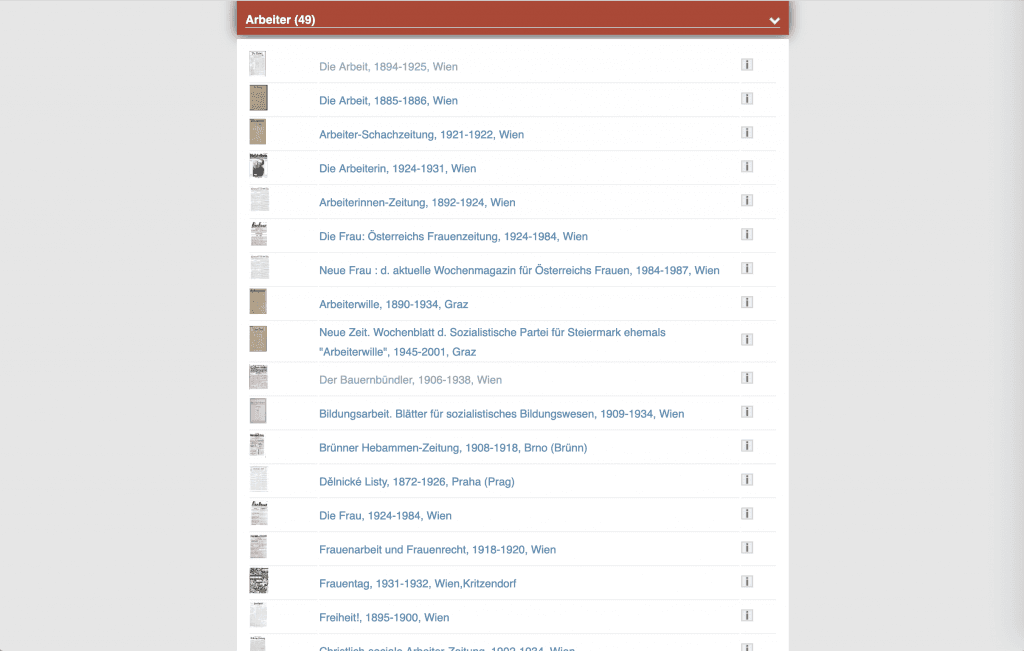
Figure 58. ANNO Arbeiter (49)
Corpus Creation in the Digital Context and Query Criticism
Finally, the most important feature for researchers using digitised newspapers is how to collect individual articles and related metadata. As we have seen, the METS/ALTO standards collect all sorts of information about the file, its context and its content. But only a very limited part of this information is easily available to users.
It is often possible to download OCR output and/or the scanned image of the article. On the Scriptorium interface, for example, users can select both the text and the image on a given page and subsequently download them.
Some interfaces offer the option of saving articles or whole issues to a personal account. Very few offer the option to directly interact with digitised collections. These interactions might include an option to correct the OCR or tag articles, as for instance on the Swiss National Library interface.
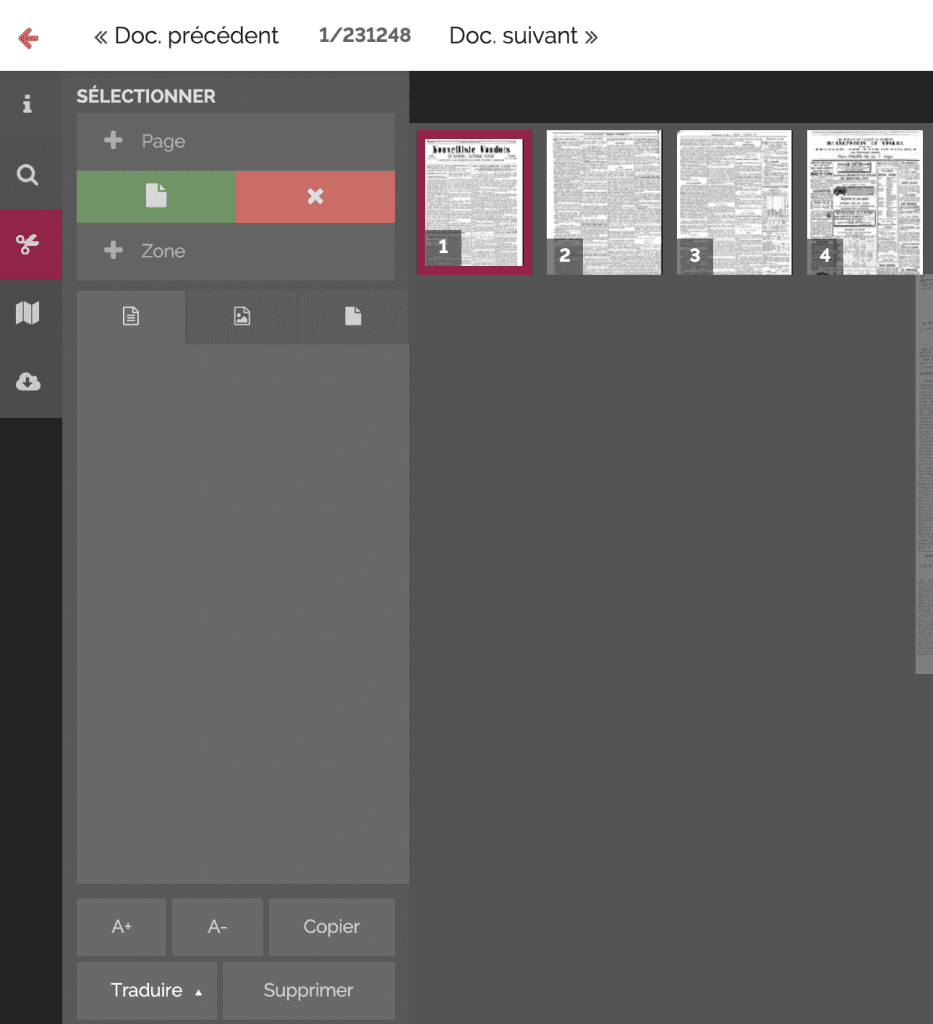
Figure 59. Scriptorium interface
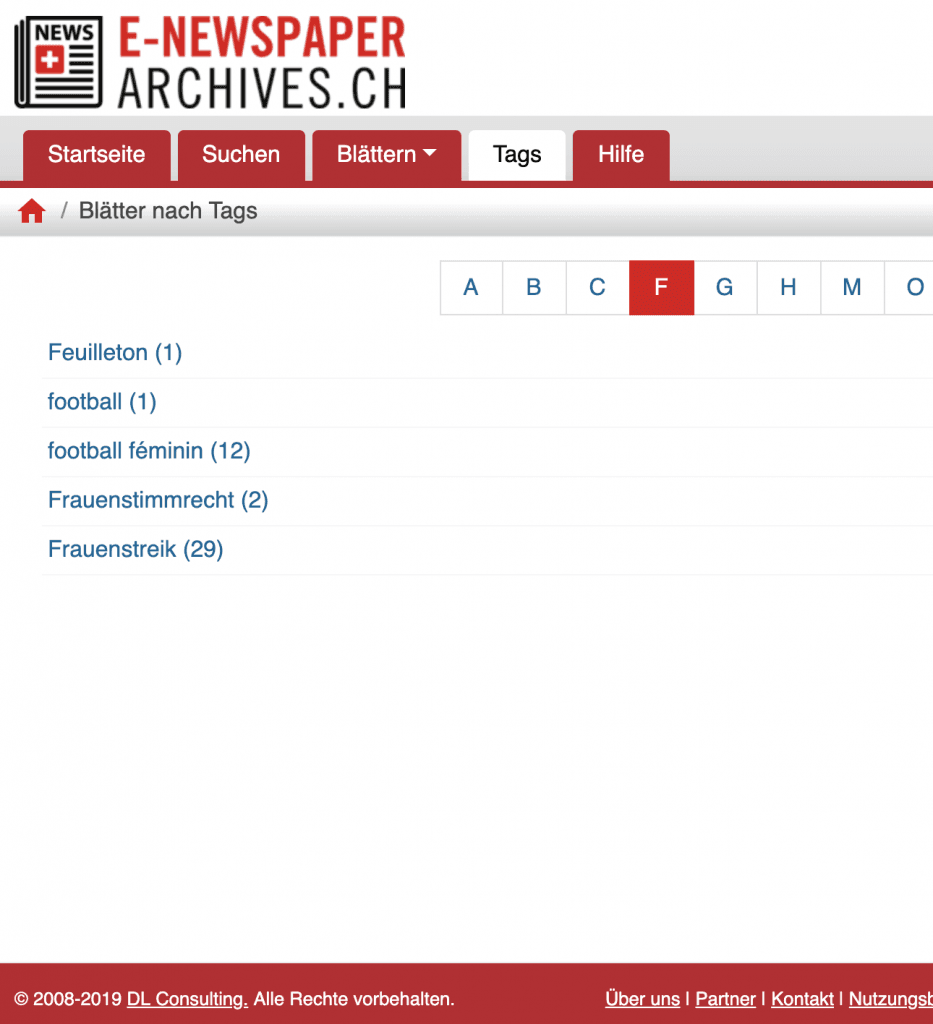
Figure 60. e-Newspaper Archives.ch interface offering option to correct the OCR or tag articles
An alternative to downloading is saving collected articles via a stable URL or permalink. This is offered by most of the interfaces produced by national libraries and is a durable way of referencing sources.
But these options remain cumbersome, especially if the research project requires a large collection of individual articles. A few national libraries offer access to an application programming interface (API), limited to copyright-free newspapers, to enable users to formulate queries and download larger datasets.
For instance the Luxembourg National Library (https://data.bnl.lu/) and the Scandinavian national libraries (hosted at https://korp.csc.fi/) have prepared ready-made datasets.
This short overview of the options offered by digitised newspaper interfaces shows how important the design of these interfaces is – and consequently, how important it is to adopt a critical approach to them.
FAQs and Documentation
Each library engaging in the digitisation of newspapers has to define the modalities of this digitisation: what level of granularity of detail? Which metadata standard to use? Will the segmentation be at page level or article level? Will there be a separate identification of articles, such as obituaries, advertisement? Each specification adds to the cost of digitisation but it also means it can be later used to create filters on the interface. These specifications are typically conveyed to the company that will perform the digitisation (See for instance the technical requirements expected from the digitisation companies by the Luxembourg National Library : https://data.bnl.lu/data/historical-newspapers/).
Some libraries give some historical information on the collections they built. For instance, Scriptorium presents sub-collections of newspaper titles, a short historical presentation and details of the digitisation process, how the digitisation was financed, or information about the copyright of an item.
Enhanced Exploration of Digitised Newspapers: Tools for Distant Reading and Clustering
The obvious added value of digitisation is facilitated access and collection possibilities. At the same time, this yields larger quantities of articles that may be more difficult to deal with. When enhanced with additional processing, digitisation can also open collections up to distant reading, i.e. the search for patterns in large amounts of texts with the help of quantitative methods, and clustering of articles according to this information. Recent efforts focus on the detection of named entities, word embeddings and topics. These options are not yet available on mainstream interfaces provided by institutions such as libraries that we presented previously. Several academic research projects are, however, now undergoing this processing to make the most of the digitised newspaper.
From Mentions of People to Named Entity Recognition
Named entities are defined entities that may include people, institutions and locations. The important criterion here is the name – specific named entities need to be differentiated from common nouns. For instance, a pope is a common, generic noun, but Pope Francis is named and therefore identifiable.
Newspapers are typically filled with references to people, institutions and locations. Identifying them and connecting articles that share named entities can help create collections or provide an overview of the themes of the articles.
To enable researchers to use this information, the collections first need to be processed in such a way that named entities are recognised, and these mentions then have to be disambiguated. References to named entities are automatically recognised and collected after an initial annotation of a sample of the collection. The granularity and detail of the annotation is defined beforehand: should all geographical entities by identified as one category or should there be a differentiation between rivers, mountains, etc.? The annotation is then used to train a program to detect any mentions in the digitised collections.
Once the mentions have been detected, then comes the difficult task of disambiguation between variations of names used for a single entity.
See some solutions to these difficulties here: link to the impresso blog via the Wayback Machine on named entity recognition with the example of a query on “Montgomery”: https://web.archive.org/web/20201127054024/https://impresso-project.ch/news/2018/06/12/tradingzone-ner.html
(DARIAH-Campus Editor’s Note: this blogpost from Impresso is no longer available on its original website, therefore a version available via the Wayback Machine has been provided)
What to Do with Digitised Newspapers?
The “pleasures and perils” coined by Richard Abel (Abel 2013) have interested researchers working with digitised newspapers over the last decade. Indeed, the digitisation of the newspapers and the subsequent possibility to apply text mining algorithms to the press articles, has opened many fields of experimentation. Libraries and researchers have imported tools from the digital humanities or are developing their own algorithms to index, analyse and link out the contents of the digitised newspapers.
In the bibliography compiled in the ‘Further Learning’ tab hereunder is a snapshot reporting from the current trends in digital research conducted on digitised newspapers, organised along four themes:
- how the digitisation changed the research practices and how scholars reflect on these changes;
- what are the efforts undergone to index the mass of digitised text contained by the newspapers;
- how to look at the visual contents of the digitised newspapers;
- how algorithms can help automatically detect newspaper segments, recurrent articles types.
As often underlined, newspapers both in analogue and digital format, constitute a massive, overwhelming source. The hope brought by the digitisation is the possibility to apply algorithms and text mining tools to help organise their content. A popular solution appeared to be topic modelling. This algorithm helps identify how some words tend to appear together in individual texts. Topic modelling relies on the assumption that some topics are frequently expressed in a similar word combination and defines from a collection of texts, a series of topics expressed by words that tend to co-occur. The output of the topic modelling is twofold: a list of co-occurring words defining the topics, and the distribution of these topics across a collection of documents. The most popular application of that principle is the latent Dirichlet allocation (LDA) that calculates the probability of words to co-occur. The interest in using topic modelling to index digitised newspapers can be found on the libraries side as well as on the research side. However, because of its probabilistic nature, it is not fully reliable and because of its unsupervised nature, it is not always easy to use the produced topics. The main advantage of the topic modelling is that because it is data driven, it can help to gain first insights into a newspaper collections and it links articles together that do not necessarily share keywords but are of semantically similar content.
Aside from the principles of the algorithm, topic modelling has a set of technical positive and negative sides. Topic modelling can function with several languages, with OCR mistakes but will be impacted by both. At the same time, it can help even identify recurrent OCR mistakes. The major hindrance for applying topic modelling to digitised newspapers collections is however the segmentation of the newspapers contents. Indeed: the topic modelling functions best if it can identify the words that appear in one document and if all articles of a given issue are merged in one document, the observation of co-occurring words will be distorted. The biggest “noise” is potentially created by advertisements where image and text are mixed up. The pre-processing steps, such as the removal of stopwords (common words carrying no autonomous meaning) or the lemmatisation (the reduction to the core form of the words), impacts the outcome of topic modelling as well.
Further Reading for “Collections of Digital Newspapers as Historical Sources”
Click to expand
Guides on the History of the Press
- Kalifa, Dominique, Philippe Régnier, Marie-Eve Thérenty, and Alain Vaillant. La civilisation du journal : Histoire culturelle et littéraire de la presse française au XIXe siècle. Paris: Nouveau Monde Editions, 2011.
- Vella, Stephen. “Newspapers.” In Reading Primary Sources: The Interpretation of Texts from Nineteenth and Twentieth Century History, by Miriam Dobson and Benjamin Ziemann, 192–208, 1 edition. London: Routledge, 2008.
- Welke, Martin. 400 Jahre Zeitung: die Entwicklung der Tagespresse im internationalen Kontext. Bremen: EdLumière, 2008.
Further Reading on the Digitisation Process
- Optical Character Recognition (OCR) : Wikipedia page: https://en.wikipedia.org/wiki/Optical_character_recognition
- METS: Metadata Encoding and Transmission Standard Library of Congress: http://www.loc.gov/standards/mets/
Wikipedia page: https://en.wikipedia.org/wiki/Metadata_Encoding_and_Transmission_Standard - ALTO: Analyzed Layout and Text Object
Wikipedia page https://en.wikipedia.org/wiki/ALTO_(XML) - Library of Congress: https://www.loc.gov/standards/alto/v4/alto.xsd
- Optical Character Recognition (OCR) – by Computerphile, with Professor Steve Simske (Honorary Professor at the University of Nottingham as well as Director & Chief Technologist at HP Labs’ Security Printing Solutions): https://www.youtube.com/watch?v=ZNrteLp_SvY
- In The Field: National Digital Newspaper Program: in the video produced by the NEH, you can follow the stages in the digitisation process, which require many stakeholders and manipulations of the original source before it can be read and analysed: Link to the NEH video: https://www.youtube.com/watch?v=LclIm9s7Iho&t=18s
- Digitisation tools at Europeana: http://www.europeana-newspapers.eu/public-materials/tools/ METS/ALTO explained by Veridian: https://veridiansoftware.com/knowledge-base/metsalto/
- Output of newspapers digitisation by ProQuest: Cornell, Jennifer. ‘LibGuides: ProQuest Historical Newspapers’.//proquest.libguides.com/hnp/searchinghnp.
Events in History and Computer Science
- “DCMI: DCMI Metadata Terms.” Accessed March 29, 2018.http://dublincore.org/documents/2012/06/14/dcmi-terms/?v=dcmitype.
- Hölscher, Lucian. “Ereignis.” Lexikon Geschichtswissenschaft: Hundert Grundbegriffe. Stuttgart: Reclam Verlag, 2003.
- “ÉVÉNEMENT : Définition de ÉVÉNEMENT.” Accessed March 29, 2018.http://www.cnrtl.fr/definition/événement.
- “Event – Schema.Org.” Accessed March 29, 2018.https://schema.org/Event.
- “Event Ontology.” Accessed March 29, 2018.http://motools.sourceforge.net/event/event.html.
- Farge, Arlette. “Penser et définir l’événement en histoire. Approche des situations et des acteurs sociaux.” Terrain. Anthropologie & sciences humaines, no. 38 (March 1, 2002): 67–78.https://doi.org/10.4000/terrain.1929.
- “Qu’est-ce qu’un événement ?” France Culture. Accessed March 29, 2018.https://www.franceculture.fr/emissions/la-conversation-scientifique/qu-est-ce-qu-un-evenement.
- “The Simple Event Model.” Accessed March 29, 2018.http://semanticweb.cs.vu.nl/2009/11/sem/#bib-SEMDOC.
Digital Source Criticism, Digital History, Digital Media History‘
- Exploring Big Historical Data: The Historian’s Macroscope’. Exploring Big Historical Data: The Historian’s Macroscope. Accessed 31 July 2019. http://www.themacroscope.org/2.0/.
- Fickers, Andreas. ‘Veins Filled with the Diluted Sap of Rationality. A Critical Reply to Rens Bod’. BMGN-Low Countries Historical Review 128, no. 4 (2013): 155–163.
- Jänicke, S, G Franzini, M F Cheema, and G Scheuermann. ‘On Close and Distant Reading in Digital Humanities: A Survey and Future Challenges’, n.d., 21.
- Jeurgens, Charles. ‘The Scent of the Digital Archive: Dilemmas with Archive Digitisation’. BMGN-Low Countries Historical Review 128, no. 4 (2013): 30–54.
- Nicholson, Bob. ‘The Digital Turn’. Media History 19, no. 1 (1 February 2013): 59–73. https://doi.org/10.1080/13688804.2012.752963.
- Zaagsma, Gerben. ‘On Digital History’. BMGN – Low Countries Historical Review 128, no. 4 (2013): 3–29.
- Ranke2 – Critical analysis of digital resources: https://ranke2.uni.lu/u/archival-digital-turn/
Topic Modelling
- Blei, David M. ‘Probabilistic Topic Models’. Communications of the ACM 55, no. 4 (1 April 2012): 77.https://doi.org/10.1145/2133806.2133826.
- Ciula, Arianna, and Cristina Marras. ‘Circling around Texts and Language: Towards “Pragmatic Modelling” in Digital Humanities’ 10, no. 3 (2016).http://www.digitalhumanities.org/dhq/vol/10/3/000258/000258.html.
- Frermann, Lea, and Mirella Lapata. ‘A Bayesian Model of Diachronic Meaning Change’. Transactions of the Association for Computational Linguistics 4 (2016): 31–45.
- Galen, Quintus Van, and Bob Nicholson. ‘In Search of America’. Digital Journalism 6, no. 9 (21 October 2018): 1165–85.https://doi.org/10.1080/21670811.2018.1512879.
- Jacobi, Carina, Wouter van Atteveldt, and Kasper Welbers. ‘Quantitative Analysis of Large Amounts of Journalistic Texts Using Topic Modelling’. Digital Journalism 4, no. 1 (2 January 2016): 89–106.https://doi.org/10.1080/21670811.2015.1093271.
- Jähnichen, Patrick, Patrick Oesterling, Gerhard Heyer, Tom Liebmann, Gerik Scheuermann, and Christoph Kuras. ‘Exploratory Search Through Visual Analysis of Topic Models’ 11, no. 2 (2017).http://www.digitalhumanities.org/dhq/vol/11/2/000296/000296.html.
- Mimno, David. ‘Computational Historiography: Data Mining in a Century of Classics Journals’. Journal on Computing and Cultural Heritage (JOCCH) 5, no. 1 (1 April 2012): 3.https://doi.org/10.1145/2160165.2160168.
- Yang, Tze-I, Andrew J. Torget, and Rada Mihalcea. ‘Topic Modeling on Historical Newspapers’. In Proceedings of the 5th ACL-HLT Workshop on Language Technology for Cultural Heritage, Social Sciences, and Humanities, 96–104. LaTeCH ’11. Stroudsburg, PA, USA: Association for Computational Linguistics, 2011.http://dl.acm.org/citation.cfm?id=2107636.2107649.
Search Practices in Digitised Newspaper Interfaces:
- ‘Compte Rendu: E-Newspaperarchives.Ch | Infoclio.Ch’. Accessed 2 August 2019.https://infoclio.ch/fr/compte-rendu-e-newspaperarchivesch.
- Crymble, Adam. ‘Digital Library Search Preferences amongst Historians and Genealogists: British History Online User Survey’ 10, no. 4 (2016).http://www.digitalhumanities.org/dhq/vol/10/4/000270/000270.html.
- Ehrmann, Maud. ‘Historical Newspaper User Interfaces: A Review’, 26. Athens, Greece: IFLA, 2019.http://library.ifla.org/2578/1/085-ehrmann-en.pdf.
- Mouhot, Jean-François. ‘Archival Review: ProQuest Historical Newspapers’. Contemporary British History 24, no. 1 (1 March 2010): 131–34.https://doi.org/10.1080/13619460903553867.
Digitised Newspaper Interfaces:
See the list on Wikipedia:
- ‘Wikipedia:List of Online Newspaper Archives’. In Wikipedia, 31 July 2017.https://en.wikipedia.org/w/index.php?title=Wikipedia:List_of_online_newspaper_archives&oldid=793300648.
Join the Zotero group on Newspapers:
- ‘Zotero | Groups > Digitised Newspapers’. https://www.zotero.org/groups/82589/digitised_newspapers.
Designing digitised newspaper interfaces:
- Moreux, Jean-Philippe. ‘Innovative Approaches of Historical Newspapers: Data Mining, Data Visualization, Semantic Enrichment’, 2016, 17.
- Whitelaw, Mitchell. ‘Generous Interfaces for Digital Cultural Collections’ 9, no. 1 (2015).http://www.digitalhumanities.org/dhq/vol/9/1/000205/000205.html.
Further Reading on Research Projects using Digitised Newspapers
- Buechel, Sven, Johannes Hellrich, and Udo Hahn. ‘Feelings from the Past—Adapting Affective Lexicons for Historical Emotion Analysis’. LT4DH 2016, 2016, 54.
- Kutuzov, Andrey, Terrence Szymanski, and Erik Velldal. ‘Diachronic Word Embeddings and Semantic Shifts: A Survey’. In Proceedings of the 27th International Conference on Computational Linguistics, 1384–1397. Santa Fe, New Mexico, USA: Association for Computational Linguistics, 2018.http://www.aclweb.org/anthology/C18-1117.
Data Visualisations and Visual Explorations of the Digitised Newspapers
- Dzogang, Fabon, Thomas Lansdall-Welfare, and Nello Cristianini. ‘Discovering Periodic Patterns in Historical News’. PLOS ONE 11, no. 11 (8 November 2016): e0165736.https://doi.org/10.1371/journal.pone.0165736.
- Torget, Andrew J., Rada Mihalcea, Jon Christensen, and Geoff McGhee. ‘Mapping Texts: Combining Text-Mining and Geo-Visualization to Unlock the Research Potential of Historical Newspapers’. University of North Texas Digital Library, 2011.
- Wevers, Melvin, and Thomas Smits. ‘The Visual Digital Turn: Using Neural Networks to Study Historical Images’. Digital Scholarship in the Humanities. Accessed 11 February 2019.https://doi.org/10.1093/llc/fqy085.
Segmentations of Digitised Newspapers
- Langlais, de Pierre-Carl. ‘Distant reading the French news with the Numapresse project: toward a contextual approach of text mining.’ Numapresse (blog), 7 February 2019.http://www.numapresse.org/2019/02/07/distant-reading-the-french-news-with-the-numapresse-project-toward-a-contextual-approach-of-text-mining/.
- Langlais, Pierre-Carl. ‘La Formation de La Chronique Boursière Dans La Presse Quotidienne Française (1801-1870) : Métamorphoses Textuelles d’un Journalisme de Données’. Thesis, Paris 4, 2015.http://www.theses.fr/2015PA040176.
- ‘Romans-Feuilletons’. Accessed 17 September 2018.http://www.numapresse.org/exploration/feuilleton/feuilleton_main/comte_de_montecristo_le.html.
- Walma, L. W. B. ‘Filtering the “News” : Uncovering Morphine’s Multiple Meanings on Delpher’s Dutch Newspapers and the Need to Distinguish More Article Types’. TS: Tijdschrift Voor Tijdschriftstudies, 7 December 2015.http://dspace.library.uu.nl/handle/1874/324205.
Research Workflows, Use-Cases and Teaching
- Abel, Richard. ‘The Pleasures and Perils of Big Data in Digitized Newspapers’. Film History 25, no. 1–2 (2013): 1–10.https://doi.org/10.2979/filmhistory.25.1-2.1.
- Hill, Mark J. ‘Invisible Interpretations: Reflections on the Digital Humanities and Intellectual History’. Global Intellectual History 1, no. 2 (3 May 2016): 130–50.https://doi.org/10.1080/23801883.2017.1304162.
- Kestemont, Mike, Folgert Karsdorp, and Marten During. ‘Mining the Twentieth Century’s History from the Time Magazine Corpus’. In Abstract Book of EACL 2014: The 14th Conference of the European Chapter of the Association for Computational Linguistics, 62, 2014.
- Mussell, Jim. ‘Teaching Nineteenth-Century Periodicals Using Digital Resources: Myths and Methods’. Victorian Periodicals Review 45, no. 2 (2012): 201–9.https://doi.org/10.1353/vpr.2012.0024.
- Strange, Carolyn, Daniel McNamara, Joshua Wodak, and Ian Wood. ‘Mining for the Meanings of a Murder: The Impact of OCR Quality on the Use of Digitized Historical Newspapers’. Digital Humanities Quarterly, 2014.https://openresearch-repository.anu.edu.au/handle/1885/64038.
- Upchurch, Charles. ‘Full-Text Databases and Historical Research: Cautionary Results from a Ten-Year Study’. Journal of Social History 46, no. 1 (1 September 2012): 89–105.https://doi.org/10.1093/jsh/shs035.
- Wijfjes, Huub. ‘Digital Humanities and Media History. A Challenge for Historical Newspaper Research’. Tijdschrift Voor Mediageschiedenis 20, no. 1 (26 June 2017): 4-24–24.https://doi.org/10.18146/tmg20277.