
Digital Humanities Research Questions and Methods


Digital Humanities and Heritage Science Research Infrastructures
Digital Humanities and Heritage Science Research Infrastructures: New Approaches to the Study of Pre-Modern Manuscripts
Pre-Modern Manuscripts
Extant manuscripts are central to the work of historians in reconstructing the history of pre-modern civilisations. While archaeology, numismatics and art are, for example, all rich sources for the study of the past, written culture, where it exists, opens important windows that would otherwise remain closed. Written culture is often preserved via manuscripts made from a variety of materials, most commonly, in western Europe, animal skins. Working with pre-modern written culture presents substantial challenges. These can arise from the languages in which texts are written, many of which are no longer in common use; to the type of handwriting and abbreviations employed; to unusual formats; to deciphering the symbolism connected with choices of colour, imagery and materials. In the last 200 years, the historical profession has developed robust palaeographical and codicological tools to address the challenges connected with accessing and interpreting the texts contained in manuscripts; in recent decades, historians have begun to develop new interests in decoding the symbolic features. However, there remains considerable untapped value in these sources. Certain research questions cannot be addressed using the traditional ‘toolkit’ that historians have employed to date. Digital Humanities and Heritage Science research infrastructures provide new tools that can help to realise more fully the value of manuscripts as a resource and, in doing so, help to broaden our understanding of the past.
Digital Humanities Research Infrastructure for Pre-Modern Manuscripts
Work in Digital Humanities has greatly expanded the means and methods for studying pre-modern manuscripts and, just as importantly, developed ways to publish scholarly editions in digital form. The most important of these developments has been the Text Encoding Initiative (TEI) guidelines begun in the late 1980s, which have supported textual scholarship in new ways and at new scales. The current version of the guidelines (‘P5’) provide the basis for rich, structured data about digitised manuscript images and transcriptions, as well as layers of metadata. These data are typically organised in a format that is both human and machine readable and can support many kinds of processing and analysis, such as entity extraction, bibliographic and source analysis, and modelling of relationships, such as author correspondence networks. Digitisation and tools like the TEI guidelines have also enabled digital publication in a variety of new forms, first through CD-ROM and then on the web. Unconstrained by limitations of space and cost, digital scholarly editions can include very high-resolution images, layers of visual or textual annotation, translations, critical apparatus, and notes – far more than any printed volume could feasibly cover. Digital publishing has also created greater opportunities for manuscript research to ‘go public’. As humanities research has become increasingly public-facing, manuscript digitisation has also enabled non-specialist involvement through crowd-sourcing or ‘citizen science’ initiatives.
Heritage Science Research Infrastructure for Pre-Modern Manuscripts
Heritage Science is a relatively new term that was coined just over 10 years ago to encompass the established fields of Archaeological Science, Conservation Science and Technical Art History, but it has since expanded to include all sciences applied to the study of heritage. In this broader definition, the part of Digital Humanities that concerns heritage documents could also be part of Heritage Science. Drawing on the experience of a number of EU funded research infrastructures for conservation science and archaeology, European Research Infrastructure for Heritage Science (E-RIHS) is being established to support interdisciplinary research in heritage science. Specifically, the research infrastructure involves 4 platforms ARCHLAB (archives), DIGILAB (virtual facilities), FIXLAB (fixed facilities) and MOLAB (mobile facilities). There is clearly an overlap between DIGILAB and parts of Digital Humanities that concerns heritage.
While the application of science to manuscript studies goes back to at least the 18th century, science has been used only occasionally and mainly for the revealing of faded or erased writings. Manuscripts are fragile and most libraries and museums today would not allow samples to be taken from manuscripts for scientific analysis which limits the range of analysis that can be conducted. In the last decade or so, technological advances have made non-invasive scientific analysis and imaging tools increasingly available for the characterisation of manuscripts. This development has meant that increasingly manuscripts can be analysed scientifically to characterise the materials and the production method in addition to revealing hidden writings. The materials and how they were used on manuscripts often allow us to distinguish between the workshops of production, different cultural or regional influences and to inform the trade and technological exchanges between different geographic locations which in turn are determined by the geopolitics at the time.
Historical Research: Requirements and Tools
Traditional historical research methods provide powerful analytical tools but are limited in some key respects. When examining manuscripts, they are often unable to answer questions that require going beyond what can be determined by the naked eye. The way in which, for example, a specific manuscript was created and evolved into its final form remains essentially hidden, and the subject of conjecture. Heritage Science Infrastructures allow us to peel back the layers involved in the process by which a manuscript evolved into its final form. This may reveal dramatic information, such as previously hidden text and images, but it can also reveal less exciting but equally important detail. Such analysis enables historians to turn conjecture into fact and to employ manuscripts as sources that allow us to dig deeper into past societies. Heritage Science Infrastructures also enable historians to develop new questions, questions that would not otherwise have been asked of a manuscript. Previously, connections between manuscripts could often be made only by comparing handwriting and artistic styles. Pigments and inks, however, can now be categorised using non-invasive techniques. This opens entirely new ways of exploring connections between manuscripts. In addition to enabling greater access to fragile material that cannot be easily viewed, Digital Humanities Infrastructures offer new ways of displaying the results of this ‘layered’ scientific analysis. However, like Heritage Science Infrastructures, Digital Humanities also creates the possibility of asking new questions. These questions enable, in particular, new approaches to the analysis of the textual content and layout of manuscripts. Like Heritage Science Infrastructures, the application of digital tools increases the value of manuscripts as sources. Together, these approaches have the potential to transform manuscripts from their traditional, primary role as repositories for text into truly multivalent resources for the examination of past civilisations.
Tools to Assist Historical Research
Digital Humanities Approach to Pre-Modern Manuscripts Research
The strengths of Digital Humanities research methods are often located in the analysis of textual phenomena at scale. Computers excel at identifying and statistically measuring patterns in large quantities of text, and so are often employed to analyse authorship style, genre or other features of writing. As programming languages and research software have become more accessible, the community of researchers employing them has grown and has in turn created resources like the “Programming Historian”, a series of tutorials on digital history research techniques. Programming libraries for tasks such as information extraction, topic modelling, and network analysis now enable many more researchers to undertake exploratory data analysis that may identify patterns of interest at scale. For example, once the text of a manuscript is digitised, named entity extraction can be used to identify person and place entities, supporting research into spelling variation, source texts, and the social and geographic context of the manuscript’s creator. Beyond the direct application of digital tools to historical research, a range of infrastructural developments in Digital Humanities now supports better exchange, linking and annotating of digitised manuscripts. One significant example is the International Image Interoperability Framework (IIIF), a project that aims to improve the way image collections from multiple sources can be used, ultimately in order to provide researchers with a more effective user interface. IIIF allows researchers to view, compare, annotate and cite manuscripts using shared technical specifications that increase the functionality for users and lower costs and complexity for developers and institutions. This is particularly important for pre-modern manuscript research, since access to the objects themselves is often difficult, and related manuscripts may be held in multiple collections around the world.
Scientific Analysis of Pre-Modern Manuscripts
Scientific analysis of historic manuscripts has been used over the years to address research questions related to the history of the manuscripts, assisting the further understanding of the relationship between history, heritage and society.
More specifically, a combination of various complementary non-invasive and/or invasive analytical techniques on historic manuscripts can provide:
Material Identification
Substrate: identification of the substrate and the method of preparation, e.g. the provenance of the paper or the animal species used for the parchment and how the substrate was sized.
Writing materials: identification of various ink compositions
Illumination materials: identification of the colouring and gilding materials as well as the binders (the binding media used to bind the pigment powder together to form a paint)
Colour as seen by the human eye cannot always distinguish between different materials, as different paints can sometimes give the same colour under certain lighting conditions (e.g. daylight, candle light etc.). In the example below (Figure 62), three pairs of paint-outs with each pair displaying the same colour are presented. Even though visually the two paint-outs in a pair look similar in colour, spectroscopic analysis shows that the materials are not the same. The pairs are: 1) cobalt blue and ultramarine; 2) azurite and smalt; 3) Prussian blue and indigo in animal glue binder. The reflectance spectroscopy (reflectance or the fraction of light reflected off the material plotted against λ – the wavelength of light) in the visible/near-infrared regime (400 to 1000 nanometres (nm)) gives the characteristic spectral fingerprint of a material. Different materials give different spectra. Other types of spectroscopy, such as X-ray fluorescence (XRF) spectroscopy gives the identification of the composition of the elements that make up the material. These two types of spectroscopy complement each other.
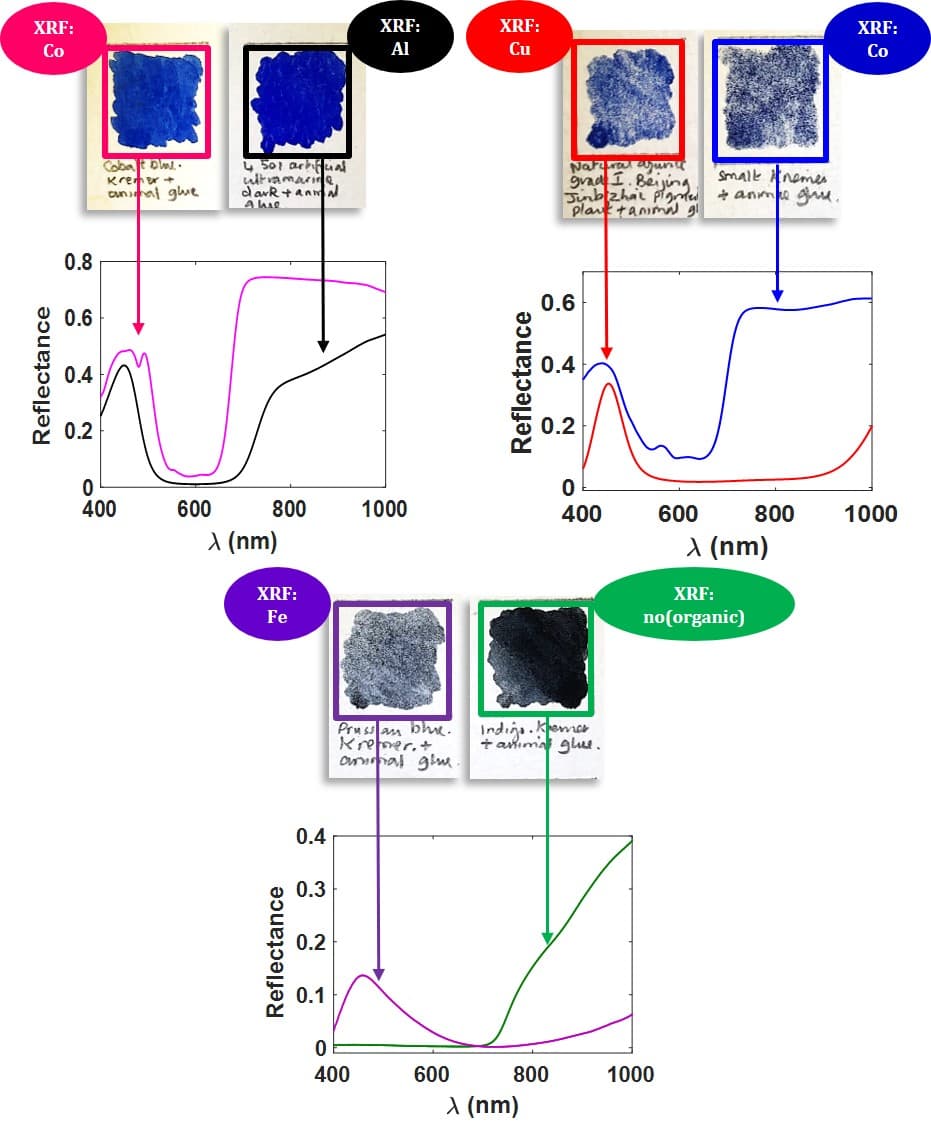
Figure 62 - Spectroscopy results
Examination of Production Techniques
In the example below (Figure 63), spectral imaging is used to capture images with a set of 10 different filters with central wavelength ranging from 400nm to 880nm, and thus collecting millions of reflectance spectra in one go. The near-infrared (880nm) image revealed the initial sketches as infrared light was able to penetrate the painting layer.
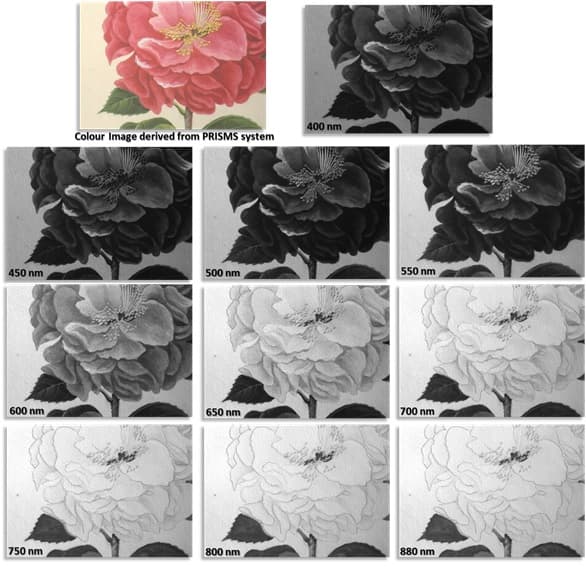
Figure 63 - Image of a flower through different coloured filters
Examination of Alterations/ Modification or Additions on the Original Manuscript
Scientific imaging of historic manuscripts, e.g. near infrared images, ultraviolet fluorescence images or spectral imaging, allows the investigation of possible alterations and later additions on the original manuscript.
Scientific Analysis of Medieval Manuscripts
The Canterbury Roll
The Canterbury Roll is a five-metre-long genealogical roll of English kings and queens. The video describes the historical context of the Canterbury Roll as well as the research requirements. The Roll, which includes a Latin text of approximately 8000 words, was written in the 1430s, the early years of King Henry VI’s reign, by an unknown individual who we have designated the “Lancastrian Scribe”. In its original form, the Roll traced the origins of English kings from the biblical figure of Noah via classical and British myth down to the Lancastrian dynasty who ruled England in the early fifteenth century. In the half century following its creation three scribes revised and extended the Roll. The Roman Numerals Scribe translated the Indo-Arabic notation of the original Lancastrian Scribe while the Yorkist and Margaret of Burgundy Scribes modified the content making it more favourable to King Edward IV, who usurped the English throne in the 1460s. The Roll entered an Aotearoa New Zealand library collection in 1918 but research into it remained limited in the twentieth century. It was identified in the 1980s as part of a wider group of related manuscripts and, along with the recent identification of two of the four scribes, this has made the Roll the focus of renewed interest.
Tools to Assist Historical Research
This section shows how the tools provided by both the Digital Humanities and the Cultural Heritage Infrastructures are used to assist the research on the Canterbury Roll.
Digital Humanities for the Research of the Canterbury Roll
This video discusses a Digital Humanities approach to research into the Canterbury Roll. In order to investigate both the Canterbury Roll and the wider “Noah” group of manuscripts, the Canterbury Roll Project was founded in 2012 as a collaboration between the University of Canterbury’s History Department and its Arts Digital Lab. The first stage of a new digital edition and translation of the Roll was launched as part of the project in December 2017. The edition is based on the standards for digitizing medieval manuscripts set by the Text Encoding Initiative. The most important benefit of digitization is the opportunity to bring the modern reading experience of the Roll closer to the medieval experience. The Canterbury Roll Project couples a student-led edition/translation project with an attempt to recreate the experience of viewing the manuscript as a roll. Unlike many existing digital projects, where rolls are presented in sections, this one presents the Canterbury Roll as one continuous manuscript. We use a series of 42 images presented via tiling software to achieve this effect while maintaining the option of employing a high powered zoom. Rather than present a series of paragraphs arranged in a set order, which is the inevitable consequence of publishing an edition of a roll in a book, the project uses a “zoned” approach to enable the reader to view any roundel or paragraph in any order. It also identifies each scribal hand in the underlying code. This means we can reconstruct a version of the text that reflects each stage of its development.
Scientific Analysis of the Canterbury Roll
The importance of the scientific analysis as well as the contribution of the Heritage Science infrastructure in research into the Canterbury Roll are presented in the video below. In 2017, the Canterbury Roll Project formed a partnership with the Imaging & Sensing for Archaeology, Art History & Conservation (ISAAC) Mobile Lab at Nottingham Trent University. This opened up the possibilities for non-invasive imaging and spectroscopic analysis of the Roll. Non-invasive spectroscopic analysis enables the identification of pigments and allow us to “strip away” layers of the manuscript to reveal “hidden” writing and images. The ISAAC Mobile Lab visited Christchurch, New Zealand in January 2018 to carry out an initial study using their in-house developed spectral imaging camera, PRISMS, for large area imaging and initial identification of the pigments, high spatial and spectral resolution reflectance spectroscopy to identify red organic pigments which are also complemented by X-ray fluorescence spectroscopy to identify the elemental make-up of the materials. Among the many findings, were a clear image of Noah’s Ark at the start of the manuscript hidden behind a later addition, a red rose, and traces of a “missing” passage that would once have described King Henry V. In addition to uncovering features such as guide letters, these discoveries provide us with new insights into the way the manuscript was constructed and the way in which it was modified.
Further Learning For the “Digital Humanities and Heritage Science Research Infrastructures” section
Click to expand
Digital Edition of the Canterbury Roll
- Chris Jones, Christopher Thomson, Maree Shirota, Elisabeth Rolston, Thandi Parker, and Jennifer Middendorf, ed., “The Canterbury Roll – A Digital Edition.” Canterbury: Canterbury University Press, 2017. Open Access: http://www.canterbury.ac.nz/canterburyroll.
- For a detailed bibliography and a project to catalogue all such scrolls, please consult the Harvard database Medieval Scrolls.
For the Canterbury Roll in its Medieval Context
- Alison Allan, “Royal Propaganda and the Proclamations of Edward IV.” Bulletin of the Institute of Historical Research 59, (1986): 146–154.
- Alison Allan, “Yorkist Propaganda: Pedigree, Prophecy and the ‘British History’ in the Reign of Edward IV.” In Patronage, Pedigree and Power in Later Medieval England, edited by Charles D. Ross, 171–192. Gloucester: A. Sutton, 1979.
- Chris Jones, “The Canterbury Roll.” In Treasures of the University of Canterbury Library, edited by Chris Jones and Bronwyn Matthews with Jennifer Clement, 85–90. Christchurch: Canterbury University Press, 2011.
- Thandiwe Parker, “A Woman’s Role: How Scribes Depicted Women On The Fifteenth-Century Canterbury Roll.” Comitatus 48, (2017): 95–115, https://doi.org/10.1353/cjm.2017.0004
- Maree Shirota, “Royal Depositions and the ‘Canterbury Roll’.” Parergon 32, no. 2 (2015): 39–61,
For Digitization of Pre-Modern Manuscripts
- For TEI: The Text Encoding Initiative
- Jasmine Elizabeth Burns, “Digital Facsimiles and the Modern Viewer: Medieval Manuscripts and Archival Practice in the Age of New Media.” Art Documentation: Bulletin of the Art Libraries Society of North America 33, no. 4 (2014): 148–167.
- Arianna Ciula and Tamara Lopez, “Reflecting on a Dual Publication: Henry III Fine Rolls Print and Web.” Literary and Linguistic Computing 24, no. 2 (2009): 129–141, https://doi.org/10.1093/llc/fqp007
- Jock Phillips, “A Click to the Past: Digital History in New Zealand.” New Zealand Journal of History 47, no. 2 (2013): 232–248.
For Heritage Science & Pre-Modern Manuscripts
- The Technological Study of Books and Manuscripts as Artefacts – Research questions and analytical solutions, eds. Sarah Neate, David Howell, Richard Ovenden, A.M.Pollard, British Archaeological Reports Oxford Ltd., 2011, ISBN-13: 978-1407307671. [e.g. Chapter 8: Advanced Optical Imaging Methods for Investigating Manuscripts can be access through the link]
- Kogou S., Neate S., Coveney C., Miles A., Boocock D., Burgio L., Cheung C.S., Liang H., The origins of the Selden Map of China – scientific analysis of the painting materials and techniques using a holistic approach, Heritage Science, Vol 4:28, DOI: 10.1186/s40494-016-0098-x (2016)
- Wijsman S., Neate S., Kogou S., Liang H., Uncovering the Oppenheimer Siddur: using scientific analysis to reveal the production process of a medieval illuminated Hebrew manuscript, Heritage Science, 6:15 (2018)
- Kogou S., Lucian A., Bellesia S., Burgio L., Bailey, K., Brooks C., Liang H., A holistic multimodal approach to the non-invasive analysis of watercolour paintings, Applied Physics A. Vol. 121(3), 999-1014 (2015)
- Liang H., Advances in multispectral and hyperspectral imaging for archaeology and art conservation, Applied Physics A. Vol 106 (2), 309-323 (2012)