
Digital Humanities Research Questions and Methods


Boosting Digital Humanities Research with Computer-Mediated Communication (CMC) data
Introducing Computer-Mediated Communication as Data
Social media is a place where people express emotions, exchange ideas and chat about whatever is on their minds. People’s behaviour on social media reflects what moves (excites or irritates) them and what their attitude is on emerging matters. Combined with easy access to large volumes of data, accompanied by rich metadata, this has opened up new opportunities for sociolinguists, communication and media studies scholars, ethnographers, anthropologists and culturologists as well as political and social scientists who have started to adopt methodologies previously used in the fields of natural language processing and data science, such as text mining, social network analysis, geospatial analysis, and data visualization, in order to structure, search, mine, manipulate, visualize, share, and combine social media data. These approaches not only enable scholars to apply the interpretative traditions of the humanities and social sciences to data on a very large scale but also allow them to address new research questions and develop novel techniques for tackling complex social phenomena (e.g. fake news, hate speech, nationalism, mental health).
Case Study 1: The Citizen Mindscapes Project
The aim of the multidisciplinary Citizen Mindscapes Project is a comprehensive socio-political and linguistic analysis of the everyday social media discourse in the Finnish society. By applying a wide range of quantitative and qualitative methods from the fields of natural language processing, statistics and machine learning to research questions in sociology and media studies, Citizen Mindscapes researchers seek to uncover the societal and political trends in Finland.
In a recent article, Pakkasvirta (2018) analyses how the concepts and words referring to Latin America are used in Finnish social media, and how this kind of interaction is built on and further strengthens national or “continental” historical stereotypes in the new media. Through the lens of the representations of Latin American stereotypes, the Finnish national self-portrait is reflected as well. The approach used combines qualitative corpus research and quantitative content analysis methods in the big social media data setting, covering a time period of more than fifteen years in the form of tens of millions of online messages on topics such as local affairs, health, food, religion, and celebrity gossip.
The study proves that strong historical stereotypes are maintained and reproduced in social media in the twenty-first century by new connective actions which also reproduce nationalism. In the forum discussions, Latin Americans are mostly discussed through the lens of a tourist. Even the posts on relationships are typically the result of travelling. The historically established attitudes permeate all categories of the analysed dataset in which Latin Americans are described as black/dark, hot-blooded, passionate, criminals, backward, jealous, religious, but also beautiful and friendly. The Latin American stereotypes observed in a U.S. poll from 1940 are still very present in the Finnish social media of the twenty-first century. This shows that attitudes and prejudices change slowly, even in the time of fast-paced Internet connective actions.
Read more: https://www.clarin.eu/blog/tour-de-clarin-finland
Case study 2: The NTAP Project
The Project Networks of Texts and People (NTAP) developed methods and tools to detect, analyse and visualize the distribution, flow and development of knowledge and opinions across online social networks in order to help general users assess, interpret and use information in the blogosphere, enable researchers to visualize and analyse information diffusion and polarization in large data sets, and support media monitoring companies in tracking the spread of statements and opinions through social media.
The project advocated using data-driven approaches to climate change discourse in blogs, which is characterized by its large scale and extremely complex, varied and dynamic nature, because automatic approaches are able to provide manageable overviews of the content, point out interesting linguistic patterns and automatically annotate the material. Furthermore, the project showed that while some problems can be tackled by treating texts as bags of words and analysing language only at the level of lexis, identification of higher-level linguistic patterns is often necessary. This can be only partly achieved with the established corpus linguistic techniques, which is why the researchers in the project investigated other text mining and visualization tools as well.
In a recent publication, Elgesem et al. (2015) analysed the texts of 1.3 million English blog posts on climate change and the structure of the links between the blogs in which these posts appeared. They combined community detection techniques with probabilistic topic modelling to show how topics related to climate change are discussed across various parts of the English blogosphere. They identified one community of predominantly climate-sceptical bloggers and several accepter communities. Although they observed a series of topics that are characteristic of the climate change discourse in the blogosphere, two turned out to be particularly prominent for characterizing the discourse: one related to climate change science and one related to climate change politics. Interestingly, they also found that the distribution of topics over the communities cuts across the divide between sceptics and non-sceptics. Despite shared topics, differences in the patterns of interactions between the sceptics and different groups of accepters were identified.
Case Study 3: The SoSweet Project
The main goal of The SoSweet project is to provide a detailed account of the links between linguistic variation and social structure on Twitter, both synchronically and diachronically, using novel interdisciplinary and quantitative approaches on much larger samples of data than were used in traditional sociolinguistic studies.
In one of their recent papers, Abitbol et al. (2018) investigated the socioeconomic dependencies of linguistic patterns on Twitter by combining a large corpus of geo-tagged French Tweets with detailed socioeconomic maps obtained from the National Institute of Statistics. They focused on three linguistic phenomena: the rate of standard negation, the rate of plural agreement and the size of the vocabulary set and tested whether their usage depends on the socioeconomic status, tweeting location, tweeting time and social network of Twitter users.
By establishing a detailed multidimensional correlation, they found that socioeconomic indicators and linguistic variables are significantly correlated in that Twitter users with a higher socioeconomic status are more prone to use more standard variants of language and a larger vocabulary set, while Twitter users on the other end of the socioeconomic spectrum tend to use more non-standard terms and, on average, a smaller vocabulary set. Related to that is their finding that Twitter users from the North of France tend to use more non-standard terms and a smaller vocabulary set compared to the users from the South. Standard language was more likely to be used during the daytime while non-standard variants were predominant during the night, which is again related to the activity of the users from different socioeconomic statuses. Finally, by observing a higher similarity of the linguistic footprints of Twitter users who are connected and have the same socioeconomic status as the disconnected users, they showed a linguistic link between the social network and status homophily.
Social Media Corpora in CLARIN Resource Families
CLARIN Resource Families
CLARIN for Researchers is an on-line collection of training materials, case studies and expert contacts from the entire CLARIN network, aimed at researchers and students of all stages who are working in the fields of Digital Humanities and Social Sciences and are interested in analysing language data and using text processing tools that are available in the CLARIN infrastructure.

Figure 30 - Infographic of the ‘CMC Corpora’ content in the CLARIN Resource Families
Corpora of Social Media and User-Generated Content
The CLARIN infrastructure offers 12 corpora compiling social media and user-generated content for 8 languages: Czech, Dutch, Estonian, Finnish, French, German, Lithuanian, Slovenian. Most of these corpora are richly tagged as well as available under public licences. In the vast majority of cases, the corpora can be directly downloaded from the national repositories or queried through easy-to-use online search environments.
An overview of the existing social media corpora is available here:
https://www.clarin.eu/resource-families/cmc-corpora
Using Social Media Corpora in CLARIN
In this section, we show how a social media corpus available through CLARIN can be queried. We focus on the Twitter corpus Janes – Tweet 1.0, which is a corpus of Slovenian tweets and one of the most important resources for the analysis of computer-mediated Slovenian and, by extension, contemporary Slovenian. The corpus contains 139 million tokens and consists of Tweets that were written between 2013 and 2017 by Slovenian Twitter users, is characterized by rich metadata and multiple levels of linguistic annotation. It has served as a basis for several interdisciplinary analyses, such as distributional modelling of semantic shift detection, author profiling and even for multilingual comparative analyses.
The corpus can be downloaded from the CLARIN.SI repository and can be accessed via two concordancers; the noSketchEngine, which is an open source version of SketchEngine, and KonText, which is a concordancer developed by the Czech CLARIN consortium LINDAT. In what follows, we demonstrate how the corpus is queried through KonText.
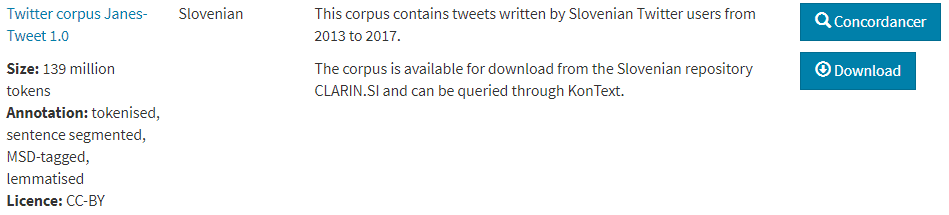
Figure 31: Description of Twitter corpus Janes – Tweet 1.0 in the CLARIN resource families with hyperlinks to the concordancer and the CLARIN.SI Repository, from which the corpus can be downloaded.
KonText is a powerful concordancer with an easy-to-use interface which supports different types of queries, as shown in Figure 32.
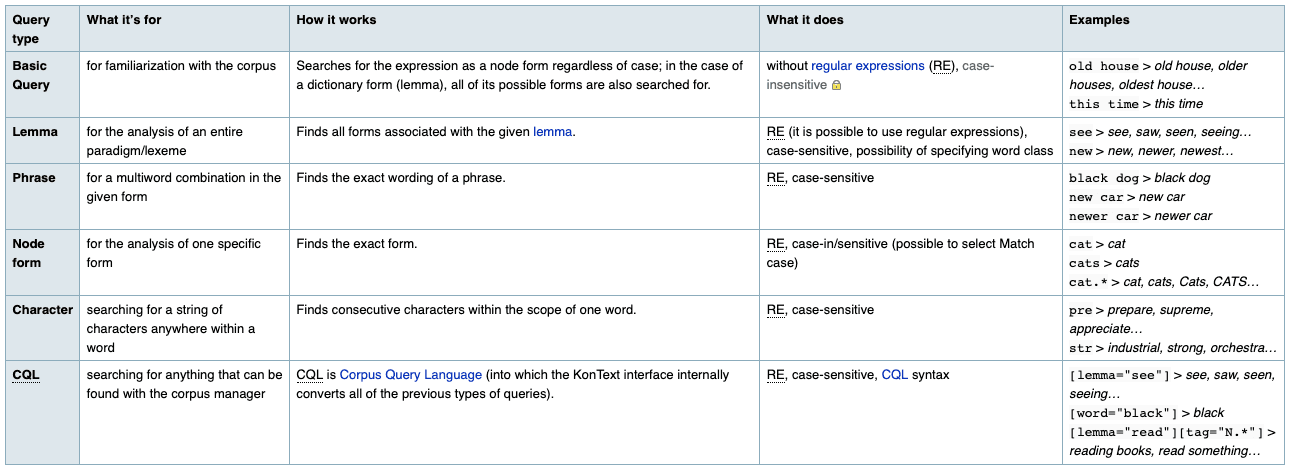
Figure 32: Explanation of the supported types of queries in KonText with examples.
One of the most important characteristics of the Janes Tweet corpus is that it normalised, which means that all the words which deviate from the standard spelling have an assigned standard variant. This makes it possible to study all the variants of a word with a single query, which is shown in Figures 33–35.
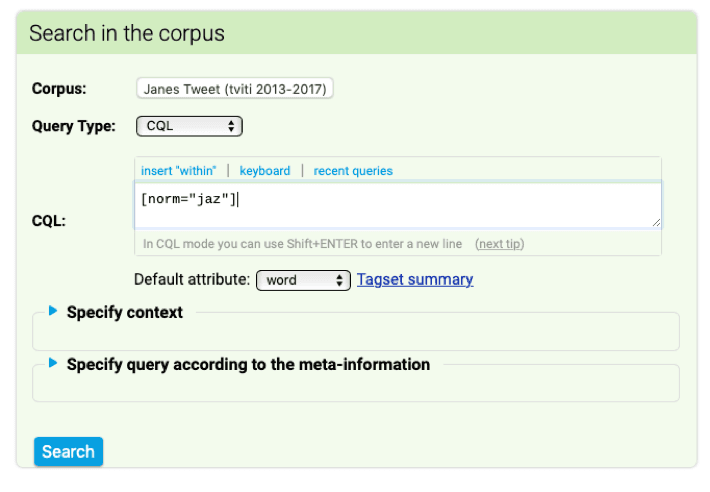
Figure 33. Query for all the spelling variants of the personal pronoun jaz (Eng. “I”).
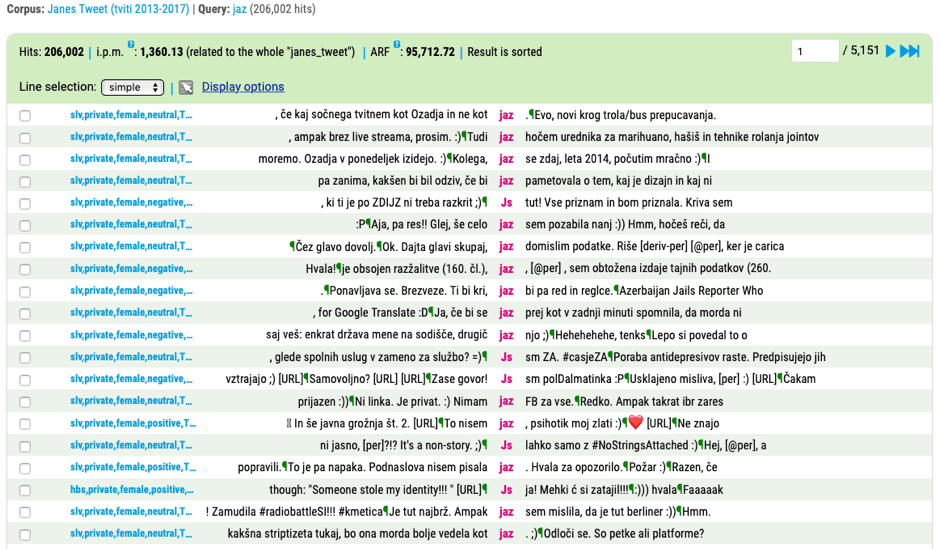
Figure 34. Excerpt of the concordances for the spelling variants of the personal pronoun jaz (Eng. “I”) with absolute and normalised frequencies at the top and the available metadata on the left.
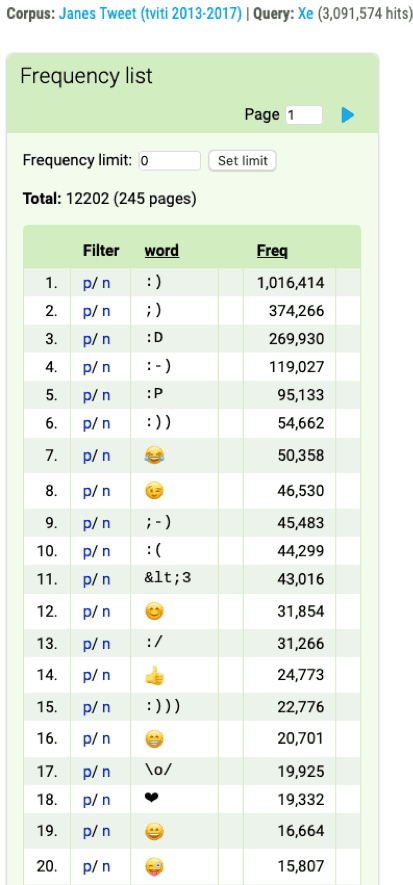
Figure 35. Frequency list of the lowercased spelling variants of the personal pronoun jaz (Eng. “I”)
By clicking on the positive filter p in the first column, all the concordances of this spelling variant in the corpus are displayed. By clicking on the negative filter n in the first, column all the concordances of all the spelling variants in the corpus except the selected one are displayed. As can be seen from the results, as many as 35 different variants have been identified. The standard variant jaz is still by far the most frequent (58%). Among the rest, apart from some obvious typing (e.g. jazj) and normalisation errors (e.g. jet, sj), several variants contain multiplied vowels or consonants (e.g. jaaaaz, jazzzz) typical of social media discourse. Variants with phoneticized spellings, such as jst (18%), js (12%) and jest (6%), are particularly frequent, and we can also observe some dialectal variants, such as ge and ges from the north-eastern region of Prekmurje.
In addition to linguistic annotation, the Janes Tweet corpus is also enriched with metadata describing valuable contextual information about each specific tweet or Twitter user. They can be used to filter corpus queries by clicking the option Specify query according to the meta-information below Query.
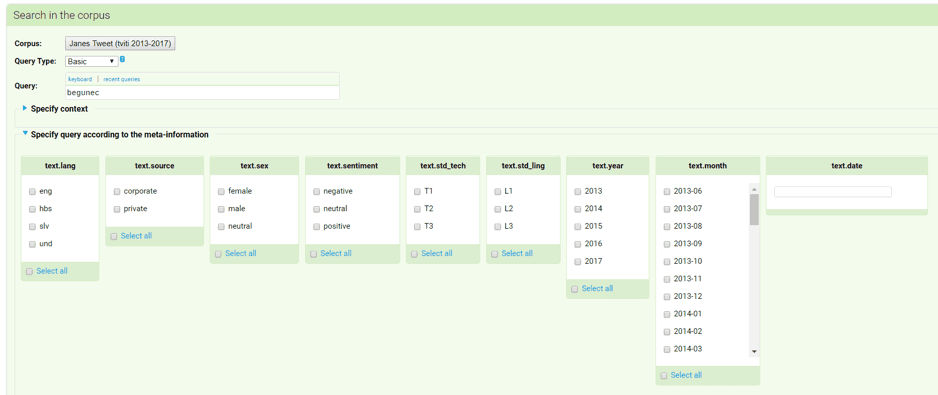
Figure 36. KonText offers an option to specify various contextual parameters of the Tweets you are interested in.
The corpus contains the following metadata:
- Language. Specifies the language of tweets (English, Bosnian/Croatian/Serbian, Slovenian, Other).
- Source. Specifies the type of Twitter users (private or corporate).
- Gender. Specifies the gender of Twitter user (male, female or neutral – in case it was impossible to identify the gender of the author).
- Sentiment. Specifies the sentiment of tweets (positive, negative or neutral).
- Technical and linguistic standardness level. Specifies the level of standardness of a tweet. Technical standardness takes into account typographic deviations from the norm (such as spaces, capitalization, final punctuation etc.) while the linguistic standardness focuses on the orthographic, lexical, syntactic and punctuation deviations from the norm.
- Year/Month/Date. Specifies when a tweet was published.
The metadata can be used to investigate the characteristics of the language used on social media. For example, we can investigate whether a certain word or phenomenon is more characteristic of non-standard language, specific to a certain type of user, or more prominent for messages with negative sentiment. We demonstrate this on the word bizarka (Eng. informal expression for something very unusual, quirk) in Figures 37-39.
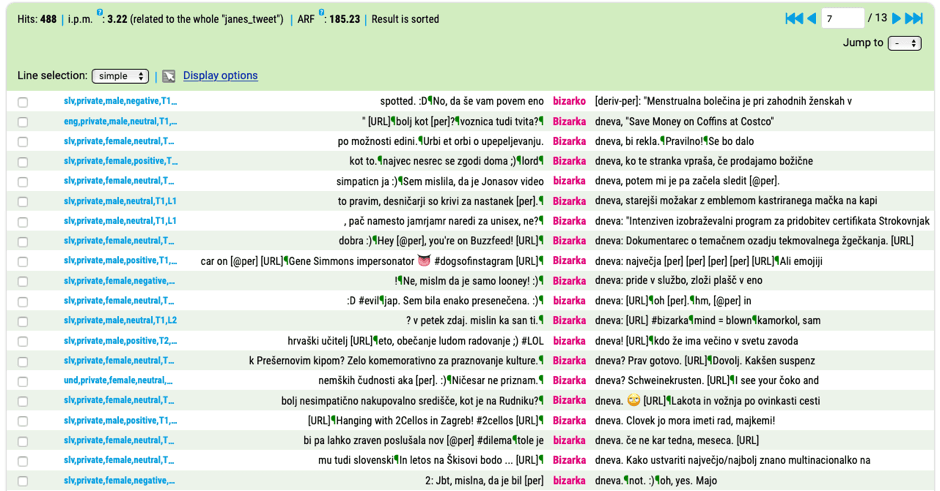
Figure 37. Concordances for the lemma bizarka (Eng. quirk) which have been sorted according to its right context. The results suggest that bizarka dneva (Eng. weird news of the day) is a frequent collocation.
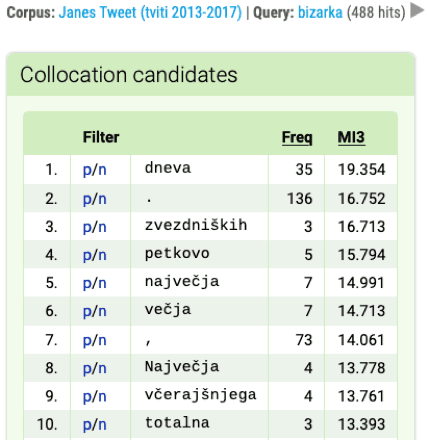
Figure 38. Collocation candidates for the lemma bizarka (Eng. quirk) confirm the above finding and add the following strong candidates to the list: zvezdniška bizarka (Eng. celebrity quirk), petkova bizarka (Eng. Friday quirk), (naj)večja bizarka (Eng. bigger/the biggest quirk), bizarka včerajšnjega dne (Eng. yesterday’s quirk), totalna bizarka (Eng. total quirk).
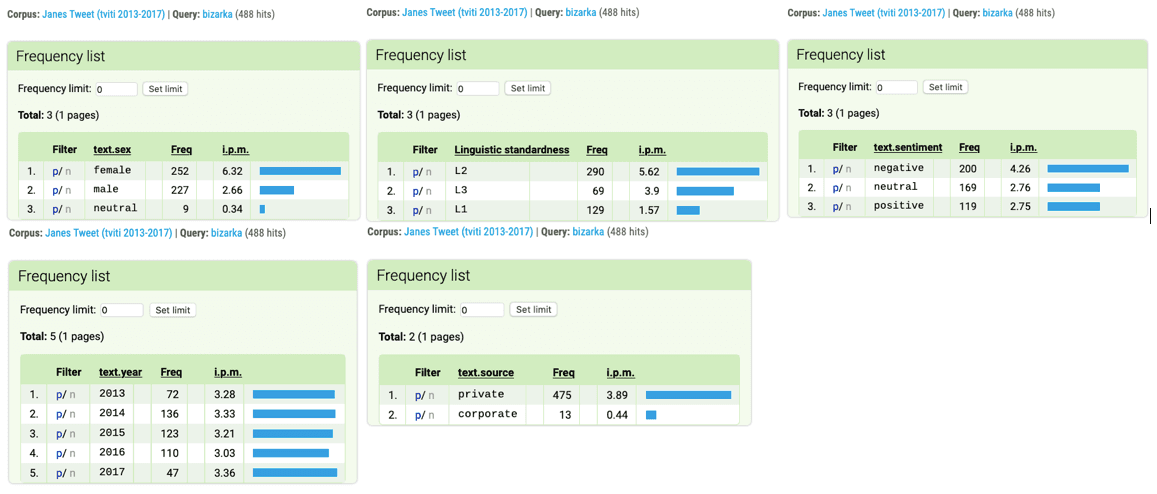
Figure 39. Frequency lists of the lemma bizarka (Eng. quirk) according to the metadata show that the word is used almost exclusively by private users. It is predominantly used by female Twitter users, typically appears in tweets written in informal language and is slightly more characteristic of tweets with negative sentiment. The usage of the word in the five years covered in the corpus is stable, ranging from 3.03 to 3.36 instances per million.
In addition to regular parts of speech, the Janes Tweet corpus has special tags for emoticons and emojis (e.g. ;), , 💅), hashtags (e.g. #EuroBasket2013, #slo, #sampovem), mentions (e.g. @ErikaPlaninsec, @Simobil, @petrasovdat) and URLs (e.g. XXX@siol.net, quicklog.me, podarimalico.si). The tags are Xe for emoticons and emojis, Xh for hashtags, Xa for mentions and Xw for URLs so they too can be queried with CQL. This is demonstrated in Figures 40-42.
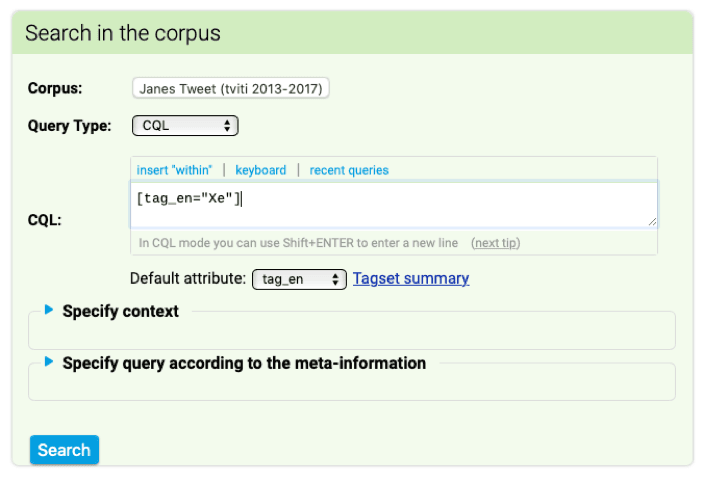
Figure 40. Using CQL to search for emoticons and emoji. The regular expression [tag_en = “Xe”] returns all the tokens in the corpus which are tagged as Residual (X) and identified as emoticons or emoji (e). All the tags used in the corpus are documented in the Tagset summary.
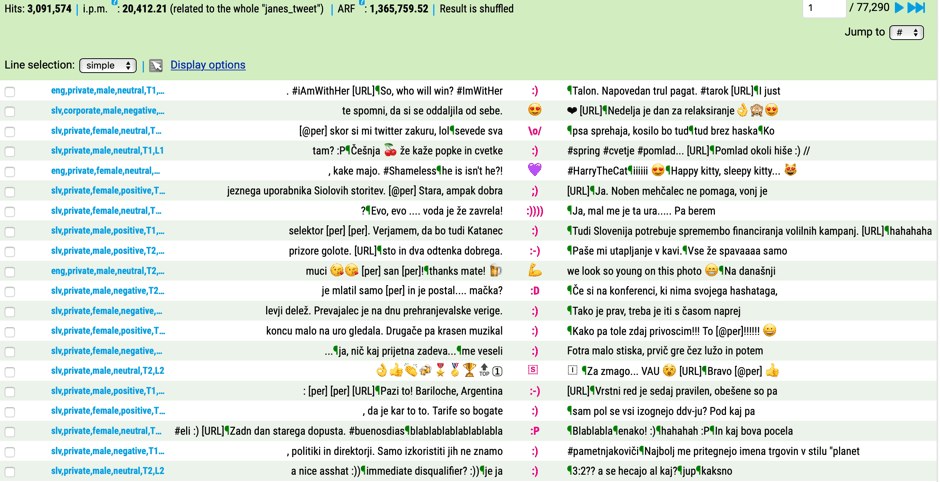
Figure 41. The KWIC (“Keyword in Context”) view of the emoticons and emoji in the corpus.
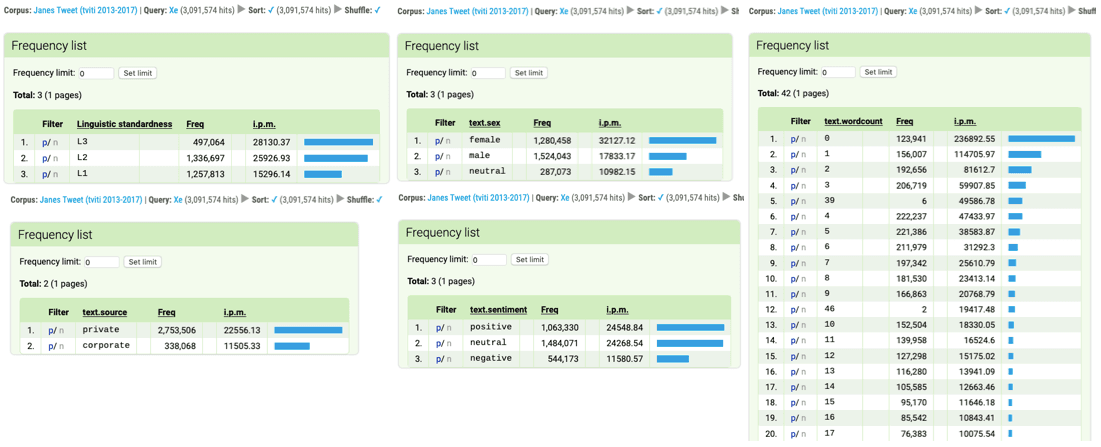
Figure 42. 20 most frequent emoticons and emojis in the corpus of Slovene tweets. The list can be accessed by clicking on the Frequency tab in the KWIC view in Figure 22. For an international study on emoji usage on Twitter, see Ljubešić and Fišer (2016a).
Further Learning in ‘Computer Mediated Communication’
Click to expand
Project websites
- Conference series Computer-mediated communication and social media corpora for the Humanities. Link to publisher’s website: http://cmc-corpora.org
- CoMeRe project. Link to publisher’s website: https://corpuscomere.wordpress.com
- DiDi project. Link to full text: http://www.eurac.edu/en/research/autonomies/ commul/projects/Pages/projectdetails.aspx?pid=11204
- Dortmund Chat Corpus project. Link to publisher’s website: http://chatkorpus.tu-dortmund.de/
- JANES project. Link to publisher’s website: http://nl.ijs.si/janes/
- SoNaR-CMC. Link to full text: https://portal.clarin.nl/node/4195
- What’s up Switzerland project. Link to publisher’s website: https://www.whatsup-switzerland.ch/index.php/en/
References
- Alexandra Georgakopoulou, Tereza Spilioti, 2015: The Routledge Handbook of Language and Digital Communication. London: Routledge.
- Katrin Weller, Axel Bruns, Jean Burgess, Merja Mahrt and Cornelius Puschmann, 2014: Twitter and society (Vol. 89). Peter Lang.
- Crystal, David, 2011: Internet Linguistics: A Student Guide. New York: Routledge.
- Fišer, D., Ljubešič, N. 2018. Distributional modelling for semantic shift detection. International journal of lexicography. [DOI]
- Ljubešić, N., Fišer, D. 2016a. A Global Analysis of Emoji Usage. Proceedings of the 10th Web as Corpus Workshop. Berlin, Nemčija. [PDF]
- Ljubešić, N., Fišer, D. 2016b. Private or Corporate? Predicting User Types on Twitter. Proceedings 2016 The 2nd Workshop on Noisy User-generated Text (W-NUT). Osaka, Japonska. [PDF]
- Miličević, M., Ljubešić, N., Fišer, D. 2017. Birds of a feather don’t quite tweet together: An analysis of spelling variation in Slovene, Croatian and Serbian Twitterese. Fišer, D. & Beißwenger, M. (ur.). Investigating Computer-Mediated Communication: Corpus-Based Approaches to Language in the Digital World, 14-43. Ljubljana: University Press, Faculty of Arts. [PDF]
Texts you may find useful:
- Quick start guide for SketchEngine. Link to publisher’s website: https://www.sketchengine.eu/quick-start-guide/
- User manual for Kontext. Link to publisher’s website: https://wiki.korpus.cz/doku.php/en:manualy:kontext:index
- Brief tour through CoCA. Link to publisher’s website: https://corpus.byu.edu/coca/help/whereStart.asp